Friday, September 30, 2005

Talking about estate plans


Baby Boomers don't like talking to their parents about estate planning, and for a number of logical reasons. They don't want to appear greedy, they don't want to acknowledge their parents' mortality and they're just not comfortable having such a significant yet stressful conversation with their folks.

But the Hartford Financial Services Group recently released the results of a study suggesting that Boomers should get over their hang-ups and have that chat with mom and dad because it's what their parents really want.

Hartford surveyed older parents ages 70-79 and adults 45-65, primarily Boomers with at least one living parent. Here are the key findings:
  • 76 percent of older parents say they are very comfortable with talking about their estate compared to 45 percent of Boomers who say they are very comfortable
  • Parents are far more comfortable discussing the content of their wills than their children realize, with 71 percent of parents saying they are very comfortable compared with 54 percent of children
  • Boomers underestimate the importance that parents place on providing for their heirs, improving their children's lifestyles, helping their children prepare for retirement, and helping grandchildren attend college
  • Significantly more older parents report having important estate planning documents such as living wills and durable power of attorneys than Boomers report they are aware of
  • Almost all older parents report talking to their children about their estate plan but fewer Boomers claim to have had this discussion
  • In general, Boomers say that their actual knowledge about their parents' estate issues is significantly less than their parents claim
What should we glean from all this? Quite simply, have the conversation. Look for an appropriate time and start the dialogue. You'll be glad you did.

Wednesday, September 28, 2005

Just a tad short


The granddaddy of all marathons is held in Boston every Patriots' Day. To be an official participant, a runner must "qualify" by running another marathon in a specified time depending on age and sex. A few participants in Saturday's Kansas City Marathon are bound to be a bit disappointed.
To the 440 of you who trained hard, tested your endurance and thought you ran a marathon in Kansas City Saturday:

You didn't.

The hilly course that stretched from downtown to Swope Park and back was about .4 mile short of regulation length because of a mix-up at the loop in front of the Liberty Memorial.
The Kansas City Marathon is certain to be thrown out as a qualifying marathon for Boston because of the foul-up. Oops.

Saturday, September 24, 2005

"A magnitude 3.2 event"


I heard the loud BOOM in my sleep but it wasn't enough to bring me to full consciousness. The bed shaking and cats flying in all directions got me to stir a bit and then Mrs. THC asked, "Was that an earthquake?"

The U.S. Geological Survey says it was a 3.2 and was located:

2 km (1 miles) NE (48 degrees) from Piedmont, CA
4 km (3 miles) NNE (14 degrees) from Oakland, CA
6 km (4 miles) E (93 degrees) from Emeryville, CA
19 km (12 miles) ENE (70 degrees) from San Francisco City Hall, CA

Gee, those are pretty much the directions to our house.

Friday, September 23, 2005

Top dogs' top firms

The wealthiest Americans have excellent brand awareness of the big investment firms yet many of them favor small, boutique asset management outfits.

These are the findings of the Luxury Institute, a New York firm that surveys the upper 10% of Americans about their preferences. These upper-crusters represent about 11 million households with an average net worth of $2.7 million and they own 77% of all stocks and mutual funds.

The survey indicated that wealthy Americans enjoy the attention lavished upon them by boutique wealth management firms and the independence of their advisors.

They were asked:

"Which wealth management brands are you aware of?"
  • Merrill Lynch 82%
  • Charles Schwab 76%
  • Smith Barney 73%
  • Fidelity 69%
  • Goldman Sachs 65%
  • Morgan Stanley 65%
  • J.P. Morgan Private Bank 62%
  • Citigroup Private Bank 60%
  • Lehman Brothers 60%
  • Bank of America 54%

Monday, September 19, 2005

The carnivals are up!


The Carnival of Personal Finance and The Carnival of the Capitalists are both up at Optimized Living and Willisms, respectively. There are lots of great entries at each carnival and here are two of my favorites:

On the personal finance front, Financial Baby Steps, presents a great baby gift idea from a rather unique perspective. Very creative.

From The Carnival of the Capitalists, Joe Kristan of Roth and Company relays news of a little accident on the San Mateo Bridge that impacts about 30,000 estimated tax payments. Liquified, huh?

(The photo is the album cover from Leon Russell's "Carney" from 1972. I owned it on 8-track).

Saturday, September 17, 2005

Widgets and free credit reports


Beginning this month consumers in all fifty states are entitled to a free copy of their credit report from each of the big three credit reporting firms, Equifax, Experian and TransUnion.

Citizens of thirteen western states were privy to free credit reports beginning last December and the privilege has gradually rolled out across the country and is now complete with fourteen eastern states, the District of Columbia, Puerto Rico and all U.S. territories going on-line September 1st.

Signed into law on December 4th, 2003, The Fair and Accurate Credit Transactions Act, is intended to ensure that lenders make decisions on loans based on full and fair credit histories and not on discriminatory stereotypes, to improve the quality of credit information and protect consumers against identity theft.

To be sure, this is a sweet deal for consumers but the CEO of Equifax doesn't see it exactly the same way.
"..It's unconstitutional to cause a public company who has a fiduciary responsibility to return profit to shareholders to give away the product," Chapman said to reporters following a speech at the Commonwealth Club of California in San Francisco..."
He has a point. What if you were in the business of making widgets and Congress comes along and tells you that you must give each American a free widget every year? Oh well, at least your two major competitors have to give everyone a free widget too. So is there anyone left who will actually buy a widget?

Certainly every one of us should check our credit histories on a regular basis to guard against inaccuracies and fraud. But these reports have been easily accessible in the past, usually for less than ten bucks. Anyone serious about protecting their credit wouldn't let a Hamilton stand in their way, would they? Free reports are a good thing for consumers, but is it really right for government to force companies to give away their product?

That said, get your free credit reports at annualcreditreport.com.

Sunday, September 11, 2005

Fibonacci, Elliott and the Nasdaq


It was July of 2000 and the Nasdaq Composite had already shed 20% of it's value, from just above 5,000 down to around 4,000. The freefall we had experienced was bad enough but what was still to come was inconceivable.

One of the firm's technical analysts had come to our office from New York to discuss his craft. (Technical analysis employs the use of historical performance to evaluate securities. It uses charts and market statistics to the exclusion of fundamentals like sales, earnings, management expertise, etc. to predict performance).

About a dozen financial advisors showed up to see the presentation and learn something about what our technical analysis department was thinking and see if there was anything useful to cull from the meeting. While most of us believed there was some redeeming value to technical analysis, it seemed a little too much like voodoo or witchcraft to hang our professional reputations on.

Part of the analyst's presentation dealt with Fibonacci Retracements combined with Elliott Waves and the uncanny accuracy this technique produced. One disbeliever asked, from the back of the room, "So, what do your fiba-what-cha-ma-call-it numbers say the market's gonna do?"

The analyst hesitated to respond but finally admitted that his analysis put the Nasdaq at between 1,000 and 1,200. That would be 2,800-3,000 points below it's value on that summer day five years ago and nearly 4,000 points below its high! Unbelievable. People walked out. It was totally absurd to even consider that kind of bloodbath. Impossible.

It took a little more than two years, but in September of 2002 the Nasdaq finally bottomed at just under 1,200, exactly as the analyst had predicted. It makes one stop and think, doesn't it?

The technical analyst who spoke to us that day was Rick Bensignor.

Thursday, September 08, 2005

The economics of wages, revisited


The members of the California State Senate apparently were all sleeping during freshman economics.
The state Senate passed a bill Wednesday to increase the minimum wage by $1 over the next two years and tie future increases to the pace of inflation, though it faces a likely veto by Gov. Arnold Schwarzenegger.
On June 13th I posted this after a study was released that suggested that many San Francisco restaurants were moving elsewhere or closing altogether due to the high minimum wage law in the city:
The conventional wisdom for raising the minimum wage, or for having one in the first place, is to help the working poor. It's very appealing to suggest that everyone should have a living wage, however, it's just not that easy.

To understand why such a law is actually harmful to low-wage workers, consider the employers' alternatives. If, for example, an employer is required to pay a worker $9 per hour for work that he values at only $6, he/she has several options. First, the employer could fire the low-wage workers and replace them with more productive employees. Secondly, he/she can outsource to contractors or worse yet, outsource to foreign workers. A third alternative is to automate. An employer can also chose to hire illegal workers who seem to be plentiful and willing to work for lower wages and virtually no benefits. Finally, as San Francisco restauranteurs are doing, they can chose to quit business altogether or relocate to an environment that is more business-friendly.
Shouldn't there be some sort of continuing education requirements for lawmakers? Or, how about some minimum educational requirements?

Wednesday, September 07, 2005

Carney time


Anyone interested in personal finance or capitalism (two of my favorite subjects) will be amused and entertained by this week's Carnival of Personal Finance and Carnival of the Capitalists. Thanks to Savvy Saver and Rethink(ip) for your hard work.

Sunday, September 04, 2005

Disaster drill for financial documents


What if you have only ten minutes to evacuate your home due to rising flood waters, a terrorist attack, a wildfire or toxic spill? Sure, you round up the family and pets, grab the photo albums and whatever family heirlooms you can carry, but what about your financial documents? What documents can you gather in ten minutes? Or would you even think to grab your important papers at all?

In an emergency situation most of us would be too overwhelmed to think about what documents we will need, or even where they are located. So, consider assembling an evacuation bag that you can grab quickly, kept in a home safe or lockbox that contains sealable plastic bags to protect documents from water. A small backpack is ideal since you may end up walking some distance and need to keep your hands free for other things.

Items to keep in the evacuation bag:
  • Cash
  • Key to your safe deposit box
  • Phone numbers for insurance agents, banks, attorneys and financial advisors
  • Account numbers for bank, credit card and investment accounts
  • Social Security Numbers for all family members
  • Current backup of computer files
  • Last three years tax returns, federal and state
  • Copies of the documents in your safe deposit box (insurance policies, wills, deeds to house and cars and your house inventory)
  • Medical information such as doctors' names and phone numbers, prescriptions, immunization records
  • Phone numbers for family and friends
  • Photocopies of birth certificates, passports, marriage certificates and powers of attorney
Cash is listed first on this list because it can be extremely important in a major disaster. ATMs will be out of service as will credit card machines that rely on phone lines for verification. Cash will be king. In situations where people are on their own for days, black markets erupt up for everything from food and water to blankets and clothing. Be assured that the guy selling toilet paper for twenty bucks a roll doesn't take American Express.

It may not be convenient, but consider keeping your safe deposit box at a bank that is some distance from your home. After all, you don't want it to be under the same flood waters as your home.

Keep credit card balances low or paid off. While this is always a good idea, after a disaster you might need to pay for weeks of living expenses before seeing an insurance check or relief money.

What other financial documents might be useful to have with you in an evacutation?

Friday, September 02, 2005

Katrina and Abraham

The CFP Board and the Financial Planning Association have notified members that they plan to offer financial planning help to the victims of Katrina. Certified Financial Planner(TM) professionals are being asked to volunteer to answer victims' questions.

Now, freshman psychology was a long time ago for me but I seem to recall something about a fellow named Maslow and his "hierarchy of needs". On that hierarchy, I'm pretty sure that food, shelter and clothing rank somewhere ahead of things like asset allocation and the tax treatment of capital gains. Katrina's refugees are asking where they will sleep tonight and how will they feed their families, not "Do I have enough international exposure in my portfolio?" or "What are the AMT implications of exercising my non-qualified stock options?"

Perhaps the CFP Board and the FPA are jumping the gun a tad but their intent is noble and I suppose it's better to be prepared too early rather than too late. Eventually the victims' focus will turn to the financial losses they have sustained and there will be important questions to be answered. I have already signed up as a volunteer.

Thursday, September 01, 2005

Gasbloggin'


I received this email from an old friend yesterday:
PETITION FOR PRES. BUSH: Presidential Petition--Please do NOT let this petition stop and lose all these names. If you do not want to sign it, please forward it to everyone you know.

To add your name, click on "forward". You will be able to add your name at the bottom of the list and then forward it to your friends. Or, if necessary you can copy and paste and then add your name to the bottom of the list.

PETITION TO LOWER GAS AND DIESEL PRICES IN THE UNITED STATES:
It then asks the 2,000th petitioner to forward it to President Bush and gave an email address. There were over 1,500 names attached.

Now folks, let's get serious. Just what do you expect the President to do about gas prices? He's had it tough enough trying to influence U.S. laws (Social Security, tort reform, etc.) how can he be expected to have any influence over the law of supply and demand?

The price of gasoline has been driven up by the forces of too many dollars chasing too few goods. More precisely, two many dollars, yen, euros and yuan chasing too few barrels of crude. Prices will come down if and when production is increased, demand is decreased, or both.

It's a really great thought that Dubya could slash pump prices back to a buck a gallon with the stroke of a pen or some sort of Presidential proclamation, but it just doesn't work that way. Sorry.

Saturday, August 27, 2005

Fruits and nuts, chips and fries


Last week Californians Attorney General Bill Lockyer filed suit for a court order requiring McDonald's, Burger King, Wendy's, Frito Lay and others to warn consumers that french fries and potato chips contain a chemical that may cause cancer.
"In taking this action, I am not telling people to stop eating potato chips or french fries," Lockyer said. "I know from personal experience that, while these snacks may not be a necessary part of a healthy diet, they sure taste good."

But consumers should have the information needed to make informed decisions about their food, he said.
The legal basis for Lockyer's suit is a 1986 ballot initiative approved by California voters known as Proposition 65 requiring the Governor to publish, at least annually, a list of cancer-causing chemicals and requires the citizens of California to be warned of the dangers.

There are hundreds of chemicals on the list including acrylamide, a natural byproduct that forms when certain carbohydrate-rich foods are fried, baked, or roasted at high temperatures. Acrylamide can cause cancer in laboratory animals at high doses, although it is not clear whether it causes cancer at the much lower levels in food. Acrylamide is found in potato chips and french fries.

There are now so many warning labels bombarding the people of California that none of them can be taken seriously, if noticed at all. Virtually any place of business that you enter, from restaurants to retail stores to auto repair shops, all must display various health warnings. The warning signs in parking garages, hardware stores and the crystal department at Macy's all read:

Warning. This area contains chemicals known to the State of California to cause cancer, birth defects or other reproductive harm.

So, instead of posting warning labels on hundreds of products and thousands of businesses throughout California, wouldn't it just be easier to post this message at the borders:

Warning: The State of California contains chemicals known to cause cancer, birth defects or other reproductive harm. Enter at your own risk.

Thursday, August 25, 2005

Gas caps


Hawaii's Public Utilities Commissioners apparently were all at the beach when they should have been in Econ 101.
HONOLULU - In an effort to gain some control over what motorists pay at the pump, Hawaii on Wednesday became the first state in the U.S. to set caps on the wholesale price of gasoline.
Any freshman economics student can tell you that price controls discourage production, leading to reduced supply and eventually shortages. Anyone remember the 70's?
Fereidun Fesharaki, an energy expert at the University of Hawaii's East-West Center in Honolulu, said the gas cap was "a stupid idea" that would be bad for competition and, ultimately, consumers.

"It may make one of the refineries shut down and leave Hawaii," Fesharaki said.

Monday, August 22, 2005

Shameless plug


Once again, my two favorite blog carnivals are fired up and running today.

The Carnival of Personal Finance is a weekly collection blog entries about, well, personal finance. Check it out at Frugal for Life and read all of the great entries.

Strange Brand has all of the Carnival of the Capitalists entries. I tried to pick a few favorites but it's going to take all week just to read them all.

Sunday, August 21, 2005

Garage doors and financial planning


Shortly after moving into our first new home we decided that electric garage door openers were an affordable luxury, especially if I installed them myself. After all, the box did say "Installs easily in an afternoon". Well, complications arose and the weekend was wasted trying to get them to work properly. I finally caved in and hired a professional who had them working beautifully in 30 minutes and for 50 bucks. The lesson: There is great value in hiring qualified professionals.

As I am not always the best student, this lesson was repeated to me a couple of short years later in the form a plumbing project gone bad. Trying to save a few bucks on a plumber resulted in a day without running water and a $500 repair bill. Life would have been so much simpler and cheaper in the long run had I just hired a professional from the start.

Shouldn't this same principle be applied to money and investing? And if so, why do so many middle-class Americans opt to go it alone when it comes to financial planning?

An article in the August issue of Southwest Airlines Spirit Magazine (not available online) titled "Equal Opportunity Planners" suggests that many don't seek out professional financial planners because they are embarrassed.
Concerns are shared by many Americans who need financial planning help, but who believe that financial planners won't go near them if they're not already wealthy. For families that barely sustain their lifestyle, the idea of a financial planner may seem even laughable. Many middle-income people either do no planning at all, or try to do it themselves. The results of such efforts can range from disappointing to disastrous.
More plausible reasons for bypassing professionals are the issues of trust and value.

Much of the mistrust in financial professionals has been brought upon them by the industry itself. A long history of fraud and abuse by a very small minority has scarred the profession. It's important to note that these occurrences, while they generate big headlines, are actually quite rare.

The value a qualified expert can add is immeasurable but the popular financial media has convinced Americans that they should never pay for financial advice when all they need is to do a little research on their own. While always important to do some of your own legwork, it's impossible for an individual to stay abreast of tax law changes, global economic developments and new investment opportunities the way a professional can.

As with garage door openers and plumbing projects, be sure to consider all possible outcomes when deciding whether to work with a financial professional. You might be surprised.

Friday, August 19, 2005

Who needs tort reform?


Vioxx, the trade name of the generic drug rofecoxib, was approved by the U.S. Food and Drug Administration (FDA) in May 1999, for the treatment of osteoarthritis, menstrual pain and the management of acute pain in adults. On September 30, 2004 the manufacturer of Vioxx, Merck & Co., Inc. (Merck) announced that it was voluntarily withdrawing Vioxx from the market worldwide, due to increased risks of cardiovascular problems (including heart attack and stroke) in users of the drug.
In May of 2001, Robert Ernst, a 59 year-old Wal-Mart produce manager from Texas, died in his sleep from arrhythmia after having taken Vioxx for eight months to relieve arthritis symptoms in his hands.

Today, a Texas jury found Merck liable and awarded Ernst's widow $253.4 million in damages, certain to increase the number of Vioxx-related suits against the drugmaker exponentially. There are already 4,200 filed.

While certain to be appealed and the award lowered, consider that attorneys in suits such as this typically take 40-50% after reimbursements for expenses.

These lawsuits-gone-wild are precisely the reason George W. Bush has urged Congress to pass some sort of meaningful tort reform. While drugmakers and all manufacturers need to be held liable for defective products that cause harm, absurd monetary awards do nothing but build personal wealth for attorneys (John Edwards' net worth has been estimated as high as $60 million), stifle innovation and create a lottery mentality for anyone who so much as gets a splinter from a broom handle. The costs are ultimately borne by all consumers and, in the case of prescription drugs, the biggest consumers are the nation's elderly.

Thursday, August 18, 2005

WSJ recognition for personal finance blogs


In Thursday's edition of the Wall Street Journal, Andrew Blackman discusses the proliferation of the blogosphere in general, and most interestingly, the growth of personal finance blogs.

Blackman singled out six blogs-of-note and three of them I visit regularly--All Things Financial, Consumerism Commentary and Free Money Finance. Congratulations gentlemen!

Sunday, August 14, 2005

OJ, pensions, ERISA and golf


Eight years after the families of Nicole Brown Simpson and Ron Goldman won $33.5 million judgments against O. J. Simpson, many are still scratching their heads that Simpson is living lavishly while much of the award remains unpaid. How can this be?

The answer is that O. J. had some pretty smart financial advisors. During his years as an NFL star and advertising pitchman, Simpson built up hefty sums in his NFL pension and personal pensions set up through various companies he established. Then he left the money inside the defined benefit plans rather than rolling it into an IRA where he may have had more flexibility with investments. Today he draws $25,000 per month from the NFL pension alone.

The Employee Retirement Income Security Act of 1974 (ERISA) states that employer retirement plans including all types of defined benefit plans "may not be assigned or alienated." The Browns and the Goldmans can't touch O. J.'s pensions.

Despite the Simpson case, it is in society's best interest to protect retirement assets from judgments and other creditors. With an already dismal national savings rate, further discouraging participation in retirement plans wouldn't be in the country's best interest. But ERISA and the subsequent 1992 Supreme Court case, Patterson v. Shumate, extended protection only to ERISA plans. IRAs, Roth IRAs, SIMPLE IRAs, SEPs, etc. were not protected.

Finally, the courts and congress have moved to extend protection to nearly all forms of retirement accounts. On April 4th of this year the U.S. Supreme Court ruled in Rousey v. Jacoway that IRAs are "similar plans" and deserved the same sort of protection afforded to ERISA plans.

Additionally, The Bankruptcy Abuse Protection and Consumer Protection Act of 2005 (BAPCPA), signed into law on April 20, 2005, and effective on October 17, 2005, has substantially increased and simplified bankruptcy creditor protection for retirement accounts. Virtually all retirement accounts will now be exempt assets in bankruptcy proceedings.

One last word about O.J.--Simpson chooses not to work since any earned income would only be seized by the court. So he is forced to play golf every day...something's just not right.

Saturday, August 13, 2005

Busy


All right, so I've been away from blogging for a bit. I've been busy.

I traveled back to the Midwest for a week to get the folks moved into their new assisted living apartment and to get the family home of 46 years ready to market. Mom and Dad are settled in and things seem to be OK so maybe I can stay home for awhile.

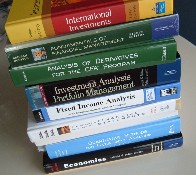
I have also launched a new project. I'll be taking a little quiz in early December over the content of these books, so much of my free time will be devoted to study. Wish me luck.