Wednesday, July 06, 2005

Smaller Smokes


First cigarette smoking was banned in office buildings and airplanes, then restaurants started segregating smokers before banishing them altogether. The no smoking cheer infiltrated even outdoor sports venues and now, the city of San Francisco has prohibited smoking in city parks. Smokers have been left with very few and very short opportunities to blaze up. Philip Morris has the answer.

Philip Morris, the giant tobacco division of Altria, has launched new shorter cigarettes. That's right, the new "Seventy-twos" are just right for that short walk from the car to the front door. Or, when it's just too hot or too cold to stand outside your office to smoke an old-fashioned 100, the new Seventy-twos fit the bill. When friends are waiting but you must have a smoke, they won't need to wait long if you're smoking the new Seventy-twos.

Now, don't misunderstand, no one is advocating smoking. Cigarettes have no redeeming value whatever. But you must admire the creativity and the innovation of American marketers. These new smokes are an example of marketing genius and capitalism at work.

BART walkout averted

From the SF Chronicle:
The deal came after union leaders extended their strike deadline from 12:01 a.m. Wednesday, first until 12:30 a.m. and then for another hour, as management mulled over a final offer from workers. Negotiators for BART and the unions met for about 26 hours over the weekend and were at the table almost continuously starting at 10 a.m. Monday.
Details of the agreement won't be announced until the unions have voted and approved the deal which could take 7-10 days.

Tuesday, July 05, 2005

BART update


As of 3:10 p.m. PDT, there was no agreement between BART and its labor unions which are set to strike at 12:01 a.m. tomorrow if a deal is not made.

From BART's website:
The latest offer BART received from its unions included pay raises and incentives that would add $58 million to BART's deficit over the next three years. BART riders and Bay Area taxpayers can't afford to pay for these increases. To keep BART's budget balanced, we need a contract that reduces the budget deficit; the latest offer would only add to it.
I, for one, will plan an early start to work tomorrow to avoid what could be one of the worst rush hours in Bay Area history.

Carnival of Personal Finance--Week 3

The Carnival of Personal Finance is up at All Things Financial and JLP's got the links to a bunch of great and helpful personal finance entries. I'm very happy to be included--my entry follows.

Alphabet soup


You thought that the world of financial planning and investment management was complex enough on its own, but now you've noticed the alphabet soup following the names of financial professionals and you're more confused than ever. What do all the letters mean and why should you care?

There are dozens of professional designations for financial professionals, but here are some of the most common ones and an explanation of what they should mean to you.

Certified Financial Planner (CFP)
Obtaining this designation is no easy task but it's quickly becoming the standard for top-notch financial advisors. Candidates complete a rigorous curriculum, pass a difficult comprehensive exam, complete 30 hours of continuing education every two years and must adhere to a strict code of ethics. If your financial advisor is not a CFP, ask him/her why not.

Certified Investment Management Analyst (CIMA)
This designation, bestowed by the Investment Management Consultants Association, requires coursework and a final exam plus three years experience in investment consulting.

Certified Public Accountant (CPA)
A CPA must hold an accounting degree and pass a four-part exam--no simple task. CPAs frequently offer other financial services or sell investments but their specialty is tax issues.

Chartered Financial Consultant (ChFC)
Like CFPs, ChFCs have broad knowledge in financial planning, estate planning, taxes and investment management. They tend to come from the insurance industry.

Chartered Financial Analyst (CFA)
Probably the most difficult designation to obtain, the CFA charterholder has passed three arduous exams over a three year period and is bound by a code of ethics. This is the desired designation for portfolio managers, mutual fund managers and stock analysts.

Chartered Life Underwriter (CLU)
The CLU designee has completed a ten course curriculum on life insurance products.

Certified Fund Specialist (CFS)
This designation, which focuses on mutual fund investing, is awarded through the Institute of Business and Finance to professionals who complete their course and comprehensive exam.

Registered Investment Advisor (RIA)
The is really not any kind of certification at all, but an investment manager who manages $25 million or more in clients' assets, must be registered with the Securities Exchange Commission and is referred to as an RIA.

While these credentials are not everything, they are indicative of a professional's dedication and desire to do his/her very best for clients. When evaluating financial professionals pay attention to other factors as well such as experience, investment style, areas of expertise or specialties and, of course, how he or she gets paid.

Monday, July 04, 2005

Coke cans and Long Dong Silver


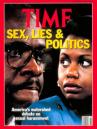
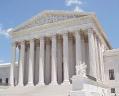
Sandra J. O'Connor's successor in the Supreme Court is expected to be named by President Bush next week and could result in a wicked Senate battle if that nominee is staunchly conservative. But the compromise reached on May 23rd by the "Gang of 14" could severely undermine any hopes Democrats have of employing the filibuster.
The pact, signed by seven Democrats and seven Republicans, says a judicial nominee will be filibustered only under "extraordinary circumstances." Key members of the group said yesterday that a nominee's philosophical views cannot amount to "extraordinary circumstances" and that therefore a filibuster can be justified only on questions of personal ethics or character.
So even if Democrats do uphold the bargain made in May, it still doesn't mean that a nominee with sharply held conservative views would be confirmed easily. The nominee could be opposed on moral or ethical grounds, genuine or contrived, as was Clarence Thomas in 1991.

Great. Another summer of Coke cans and Long Dong Silver.

Happy Fourth of July!


Sunday, July 03, 2005

Up or down


In this poorly written editorial in the LA Times (try to make sense of it if you must) their editorial board makes one good point about confirming a Supreme Court nominee:
Fourth, senators are entitled to take their time on what may be the most important votes they will cast, but the president is ultimately entitled to a yes or no on his nominee. In other words, no filibusters. They are an insult to democracy and will come back to haunt the party that misuses parliamentary process in this way.
Wow, that's powerful stuff, especially from a paper like the LA Times. Filibusters are an "insult to democracy". Why didn't they publish a statement like that a month ago?

The first three points of this editorial concern themselves with the right of senators to make full assessments of nominees, to analyze judicial philosophy and, thirdly, the right of senators to inquire about specific cases, real or theoretical.

Whomever Bush nominates to fill the existing vacancy and the one to come, the senate should be thoughtful and analytical, examine judicial philosophy but not political ideology, and vote. Period. I'm not holding my breath. This could get ugly.

Friday, July 01, 2005

Two bloggers


While attending The University of Kansas, where I studied beer, business and journalism (in order of priority) I met three wonderful co-eds who shared an apartment on the sixth floor of my building. I dated one of these roommates for two years, the second one became my best friend and my lovely wife, and the third introduced me to blogging (not in order of priority).

Mrs. THC and I had the great privilege last weekend to have lunch in Kansas City with the roommate who introduced me to blogging. Julie D. publishes The Happy Catholic and was in Kansas City for a family reunion at the same time Mrs. THC and I were back visiting family as well. It's quite an experience to get together with someone we've known for so long but get to see so rarely.

While several photos were taken of the two bloggers, this one is my favorite.

I couldn't resist


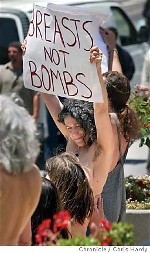
I couldn't resist posting one more photo from the Chronicle's story about the antiwar protest in Union Square. I'll leave the witty commentary up to you.

Thursday, June 30, 2005

Breasts not bombs


You see, because protests are so commonplace in San Francisco and because they are so much a part of the fabric of Bay Area living, to get proper media exposure for a successful demonstration you must be able to stand out.
Members of the au naturale contingent Breasts Not Bombs said the war is indecent, not their nakedness. "Boobies never hurt anyone," said Sherry Glaser. But after more than two years at war, the public has become desensitized to protests, they said. So if they have to show a little skin to get attention, so be it.
About a dozen antiwar activists from Mendocino County came down to show their...um...concerns about the war in San Francisco's Union Square today.

Wednesday, June 29, 2005

BART strike looms


Bay Area Rapid Transit's (BART) union employees are set to go on strike at 12:01 a.m. next Wednesday unless a new contract can be agreed upon with managers. The current contracts expire at 12:01 a.m. Friday.

UC Berkeley researchers conducted a study last year to determine the impact of a service interruption of BART which carries about 320,000 passengers most weekdays.
The morning commute on the westbound Bay Bridge could create backups stretching 26 miles, with cars driving as slowly as 9 mph, the report said.

"The mess on the freeways would spill over to city streets, and that makes things even worse. In many cases, drivers would likely spend one to two hours on city streets just to get to the freeway, crawling at speeds as low as two miles per hour,"” Jorge Laval, a PhD graduate student in civil engineering and lead author of the report, said at the time the report was released.
While it's the Bay Area's socialistic mentality to support labor in contract negociations like this, it will be interesting to see if the public will back the underworked and overpaid BART employees.
The average full- time BART union employee, they say, receives a total fringe benefits package worth $31,719 a year on top of their average annual base salary of $67,865 for a total average annual compensation of $99,584.
Not a bad gig.

Tuesday, June 28, 2005

John T. Walton dies in ultralight crash


John T. Walton, the middle of three sons of Sam Walton was killed yesterday in the crash of his experimental ultralight aircraft in Grand Teton National Park in Wyoming. Walton, whose net worth was in the $18 billion neighborhood, was 58.

It's been fashionable recently to despise Wal-Mart and the Waltons, but the SF Chronicle printed this about John:
Walton founded the Children's Scholarship Fund in 1998 to provide low-income families with money to send their children to private schools. The foundation started with $67 million from the Walton Family Foundation and benefited more than 67,000 children.

Jim Courtovich, who spent two years getting the Children's Scholarship Fund off the ground, said Walton was a devoted sponsor who "didn't just donate money, he donated time and energy." Walton would clear days at a time from his schedule to focus on the project, he said.

Courtovich also said that Walton had a casual manner and, like his father, not above doing chores himself. One time, skiing in Jackson Hole, he said Walton "had to leave early because he had to caulk his chimney."
It seems as if he was a pretty decent guy. And I hope I'm out flying around in ultralights when I'm closing on 60.

Monday, June 27, 2005

Google breaks $300


The shares of Google, the internet search leader, finished trading today above $300 and closed at $304.10, up $6.85. Google now has a market capitalization of $84.5 billion making it the 23rd largest U.S. corporation just ahead of Home Depot and just behind PepsiCo Inc.

From the Wall Street Journal:
Google's ascent has defied skeptics, whose lack of interest in Google's unusual "Dutch auction" IPO last August forced the company to lower its offering price to $85. Since then, Google's stock has more than tripled, compared with a 2% gain for the Dow Jones Industrial Average, and 1.2% rise for the tech-heavy Nasdaq Composite Index.
In spite of a P/E ratio above 120, many Wall Street analysts still have a "buy" or "strong buy" rating on the stock. Mark Mahaney, who follows the company for Smith Barney, has posted a target price of $360 on it.

Shortly after Google went public last summer, I told many clients I thought the stock was going to $50. It's starting to look as though I might need to revise my forecast.

Sunday, June 26, 2005

Estate tax sham

Saturday's Washington Post condemned an estate tax proposal by Rep. Jon Kyl (R-Arizona) as a sham but the logic employed by the Post is too flawed to be taken seriously.

America's estate tax is being gradually phased out until its complete repeal in 2010 only to return in full glory in 2011, as if it had never been phased out at all. (How lawmakers can sleep after passing such convoluted legislation remains a mystery). Kyl's proposal would allow an $8 million exclusion for each individual rather than the $1 million currently slated to return in 2011.

From the Post:
No one expects full resurrection to happen, nor should it; the amount of estates shielded from taxation at that time, $1 million, is too low. But complete repeal is unjust, unnecessary and unaffordable; it would cost $745 billion over the first 10 years, $1 trillion if extra interest costs are included. Though the House has voted to make repeal permanent, proponents of that approach don't have the 60 votes necessary to close the deal in the Senate.
Politicians and liberal journalists don't understand the meaning of the word "cost". Cost refers to an expenditure not phantom revenue. Complete repeal won't "cost" a thing. If you hoped that your grandmother would send you $100 for your birthday but she didn't, did that cost you $100? Of course not. You're disappointed, but it didn't "cost" you a cent.

The Post's opposition to Kyl's proposal is based on the idea that the U.S. cannot afford to repeal the tax without consdidering the real issue which is that the estate tax is the most unethical and illogical tax of all.

State and local taxes make sense in that proceeds are used to fund schools, police and fire departments. Taxes on items like gasoline and tires make sense in that the proceeds are used to build and maintain roads and bridges. While our income tax system is far from perfect, it still makes some sense in that the proceeds are used fund a government that maintains an economic system that allows us to earn that income. But a tax on the value of everything accumulated over a lifetime, imposed simply because you died, makes no sense at all.

The Post believes Kyl's proposed exclusion is too high and his proposed tax rate is too low.
You'd think Democrats would not only see through this sham but be eager to pick up the fight. After all, the question is whether, at a time when the gap between rich and poor is widening, extraordinarily wealthy Americans ought to be asked to give back some of what they've been able to amass. But instead of seizing on the estate tax fight as a defining issue, Democrats have scared themselves into thinking that they'll be punished for standing up against repeal.
"Give back"? Wealthy Americans were not "given" their assets by the IRS and shouldn't be required to relinquish them to the federal government just because they had the misfortune of dying. If they choose to give back at death by leaving assets to their favorite charity that should be their choice.

You paid taxes on it when you earned it. You paid taxes on what you earned through intelligent investing. You paid taxes on it when you spent it. And if you bought real property, you have paid taxes on its value every year. So who should get to decide where it goes when you die, you or Congress?

Thursday, June 23, 2005

Pirate Blogging


I'm blogging on a pirated wireless connection in Kansas where Mrs. THC and I are taking care of our three beautiful nieces, ages 9, 7 and 4 while their parents are in Italy. More later...hopefully.

Tuesday, June 21, 2005

Cooper and Kaiser

The San Francisco Chronicle's coverage of Elisa Cooper's legal struggle with Kaiser and its posting of patient data on a public website has been less than accurate and, in my opinion, not very fair to Cooper. Henry K. Lee's story today is a slightly better effort.

Monday, June 20, 2005

Kaiser fined $200,000

Kaiser Foundation Health Plan has been fined $200,000 by the California Department of Managed Health Care for unauthorized online disclosure of patient health information.
The agency's investigation found that Kaiser created a Web portal used for testing by its IT staff. The site contained confidential patient information, including names, addresses, phone numbers and lab results, and was set up and available for public viewing in 1999 "without the prior consent of those affected."
Back in January, former Kaiser employee, Elisa D. Cooper discovered the patient information on Kaiser's public website. She brought its existence to the attention of Kaiser but when they failed to do anything about the breach, she linked to the information on her blog. Cooper's actions were responsible for getting the media and the DMHC involved but has also caused her to be embroiled in legal wranglings with Kaiser.

I posted this account last month which includes an email I received from Elisa discussing some of the problems she has had with the media regarding her story. A lively discussion including participation from Alisa followed in the comments section of the May 20th post. (The comments counter reads "0", however the comments are still there).

Sunday, June 19, 2005

Fathers Day

Dad was born in a tiny town in central Iowa to a country school teacher and a jack-of-all trades in 1925. He lived there until he graduated from high school and joined the Army in World War II.

When I was a kid and we'd drive to Iowa to visit Dad's folks, I remember walking into town and everyone saying, "Oh, you're Pinky's boy!" It was like Mayberry and I was Opie, everyone knew my father even years after he grew up and moved away. I didn't think that much of it because that's how small towns are, everybody knows everybody. But as I grew older I discovered it wasn't just Iowa where so many people knew my father. All of my life I would hear, "So you must be Al's boy" or "You're the judge's son, huh?".

But Dad was not the type you'd expect to know a lot of people. He wasn't especially outgoing and he didn't get involved in lots of civic projects or events. And professionally, while successful, he wasn't a great standout. So why does this man cast such a large shadow?

What makes Dad special and the reason people know and remember him is because he is the most honest and decent man on earth. All my life I never heard him say a negative word about anyone and I'm certain he never hurt another human being. I never heard him say anything he didn't believe in his heart to be true. He's been a great father and a wonderful role model.

Dad, I hope you had a good day today. I hope every father had a good day today.

Grizzly Peak


Mrs. thc graciously volunteered to sit with our three young nieces in the Midwest for a week while my brother and his wife are being entertained by the finest wineries in Italy (it's tough being in the wine biz). So I'm left to my own devices until I join her in a few days.

This morning I pumped up the knobbies on my trusty mountain bike, dusted off the saddle and headed up the hill to Grizzly Peak Road where I took this photo.

Mrs. thc: It's sunny and 70 in the Bay, dear. What is it there, 90?