Very light blogging this weekend as business has called us to wine country. Honest, it's business. I'll be back soon...maybe.
Saturday, April 29, 2006
Rough duty
Very light blogging this weekend as business has called us to wine country. Honest, it's business. I'll be back soon...maybe.


Wednesday, April 26, 2006
Death and taxes...and taxes and taxes
 You're taxed when you earn it, taxed when you spend it, taxed when you invest it and then, if there's some left when you die, it gets taxed again. The estate tax is regarded as the most unfair of all taxes by many and it's slated to be phased out in 2010. But unless Congress acts, it comes right back to life in 2011. (Anyone who can explain what Congress was thinking when they wrote this legislation gets a gold star!)
Now this:
A new survey shows that 57% of Americans wanted to keep the estate tax - often dubbed the "death tax" - as is rather than reform it.A lot of folks have the impression that the estate tax only impacts wealthy taxpayers, but unless there is meaningful reform, millions of pretty ordinary Americans will be in for a very expensive surprise.
Just 23% said they favored repealing the tax.
The telephone survey of 910 registered voters was conducted by Washington-based research firm Penn Schoen & Berland Associates Inc. in February and released this month, just as the issue is expected to move to the forefront politically. The Senate is slated to debate next month whether reform is needed on the estate tax.
Tuesday, April 25, 2006

Sunday, April 23, 2006
Capitalists of the week
 For convincing a jury to award $32 million in the heart attack death of a Vioxx patient, the family of Leonel Garza and their attorneys win the distinction of "Capitalists of the week".
Merck, the maker of Vioxx, pulled the arthritis medication from the market in 2004 when a study linked the drug to fatal heart attacks in patients who took it for more than 18 months. Mr. Garza took Vioxx for 17 days. Garza was 71 years old when he died in 2001, had a history of smoking, suffered a prior heart attack in 1981 and had quadruple bypass surgery in 1985.
The decision was handed down by a jury in Rio Grande City in a region of Texas notorious for favoring plaintiffs.
"Many courts in other counties would toss this case because of the standard that no reasonable juror could find for the plaintiff in this situation," said Victor Schwartz, counsel to the American Tort Reform Association. "It's been our experience that many of the courts in the Rio Grande Valley are very, very friendly to plaintiffs' counsel and let cases go forward."$32 million? What a country!
The ATRA named the overwhelmingly Mexican-American region at the bottom of Texas Rio Grande Valley the nation's top "judicial hellhole" for 2005, a distinction it gives to places where judges uphold "extraordinary" jury awards and seem to favor plaintiffs over defendants.
Saturday, April 22, 2006
The week in review

- DJIA gained 209.80 or 1.88% to close the week at 11347.45. Woohoo!
- Nasdaq Composite gained 16.75 or .72% to close at 2342.86.
- S&P 500 rose 22.16, 1.72% to close at 1311.28
- 10-year Treasury yield took a breather and dropped 0.043 percentage points to finsh at 5.01%. It's still above 5%, but just barely.
Oil prices are at record highs and we're all feeling the bite at the pumps, but if it makes you feel any better, adjusted for inflation, we're nowhere close to the all-time high. The inflation-adjusted record, set in April of 1980, is $97.55 a barrel.
Cartoon by Daryl Cagle
Thursday, April 20, 2006
The third-best job
Providing financial guidance truly is challenging, rewarding and fun but I never imagined that it would rank as the third-best career choice in a survey.
Advisers couldn't have made a wiser career choice, unless they became software engineers or college professors, according to a survey of the best jobs released this month by Salary.com Inc. in Needham, Mass., and Money magazine, published by New York-based Time Inc.I've always thought that the paint department at Home Depot would be fun. I wonder where it ranks?
Advisers have average earnings of about $200,000 a year, according to the survey that accompanied the job rankings.
Wednesday, April 19, 2006
Retirement ready?
According to a new survey by the Employee Benefit Research Institue, most Americans are woefully unprepared for retirement.
Although 70% of workers said they saved for retirement, the survey found, 52% had $50,000 or less in total savings and investments, not including their home or any defined benefit plans.Will you be ready to retire?
Even more disturbing, three-quarters of workers who hadn't put money aside for retirement said that their assets totaled less than $10,000, according to the EBRI.
Tuesday, April 18, 2006
Sunday, April 16, 2006
Capitalist of the week: $144,573 per day
 Lee Raymond, the recently retired chairman and CEO of Exxon Mobil was paid more than $686 million from 1993 through 2005. That works out to be $144,573 for each day Raymond led the oil giant and it earns him the distinction of "Capitalist of the week".
Under Raymond, the company's market value increased fourfold to $375 billion, overtaking BP as the largest oil company and General Electric as the largest U.S. corporation. Net income soared from $4.8 billion in 1992 to last year's record $36.13 billion.That's some pretty handsome corporate performance. Still, is anyone really worth 144 grand each day?
Shareholders benefited handsomely on his watch. The price of Exxon's shares rose an average 13 percent a year. The company, now known as Exxon Mobil, paid $67 billion in dividends.
Saturday, April 15, 2006
The week in review
- DJIA gained 17.61 or .16% to close the week at 11137.65. Not much to get excited about but at least it's the right direction.
- Nasdaq Composite gave up 12.91 or .55% and closed at 2326.11
- S&P 500 lost 6.38, .49% to close at 1289.12
- 10-year Treasury yield rose .088 percentage points and stands at 5.053%. First time above 5% in years.
- Oil gained another $1.93 to rise to 69.32/barrel. I broke the $50 mark on a fill-up this week with mid-grade at $3.09. Yippee.
This week they released a seasonal outlook warning us to expect higher gas prices this summer. While this might not seem like headline news, doesn't it pretty much give oil companies a green light to go ahead and start raising gas prices? Thanks a lot.
Perhaps the Energy Department should just keep its big gas flap shut.
Friday, April 14, 2006
Tax quiz
 For the 2005 tax year, the top marginal tax rate is 35% which is, historically, pretty low. What was the highest marginal tax rate in U.S. history?
a) 38%
b) 45%
c) 91%
d) 94%
Tuesday, April 11, 2006

Sunday, April 09, 2006
Capitalist of the week: Hugh Hefner
 Hugh Hefner, one of America's great capitalists, celebrates his eightieth birthday today.
"I never intended to be a revolutionary. My intention was to create a mainstream men's magazine that included sex in it. That turned out to be a very revolutionary idea."Born and raised in Chicago, Hefner served in the Army toward the end of World War II. He graduated in two and a half years from the University of Illinois Champaign/Urbana while drawing cartoons for the Daily Illinois.
- Hugh Hefner
After several jobs in advertsing and publishing, Hef decided to launch his own magazine. The first issue of Playboy hit newstands in December of 1953 and featured the now-famous calendar photo of Marilyn Monroe. That first issue, produced on the kitchen table of Hef's southside Chicago apartment didn't have a cover date because he wasn't sure he could afford to publish another. But that first issue sold more than 50,000 copies and Hefner's entertainment empire was born.
Happy birthday, Hef!
Saturday, April 08, 2006
The week in review
- DJIA gained a whopping 10.72 or .10% to close the week at 11120.04
- Nasdaq Composite gave up .77 or ..03% and closed at 2339.02
- S&P 500 jumped .67, .05% to close at 1295.50
- 10-year Treasury yield rose ..108 percentage points and stands at 4.965%
- Oil gained another $.76 this week to 67.39.
Oh yeah, there was a national championship basketball game on Monday. Congrats to the Florida Gators!
There was some financial data released this week but a quick look at the market stats above would indicate there weren't any big surprises.
Don't forget, there are just nine days left to get your taxes filed!
Tuesday, April 04, 2006
Regulatory Update
Capital Gains--The House and Senate cannot agree on a provision to extend for two years the 15% maximum capital gains rate. Democrats in the Senate want the provision left out.
Dems looking to raise taxes...who'd a thunk it?
Capital Gains, Part II--Evan Bahy, D-Indiana, proposed last month that fund companies and brokerages be required to report clients' cost information to the IRS making it more difficult for folks to fudge when reporting their gains and losses.
That's a switch, a politician who doesn't trust the people.
Estate Tax--Senate Majority Leader Bill Frist, R-TN, said last month that he intends to bring a bill to the floor of the Senate in May that would permanently repeal the death tax. It came close to a vote in August but was shelved as Congress dealt with Hurricane Katrina.
Catastrophe Savings Accounts--A bill introduced by Rep. Tom Feeney, R-FL, would allow folks to establish separate savings accounts to set aside money for "qualified disaster-related expenses." Investment returns could accumulate tax-free like health savings accounts but with limits tied to deductibles on homeowners insurance.
Can Congress make things any more complicated? Oh well, it's job security for financial advisors.
To keep up with any of these bills, go to The Library of Congress.
Dems looking to raise taxes...who'd a thunk it?
Capital Gains, Part II--Evan Bahy, D-Indiana, proposed last month that fund companies and brokerages be required to report clients' cost information to the IRS making it more difficult for folks to fudge when reporting their gains and losses.
That's a switch, a politician who doesn't trust the people.
Estate Tax--Senate Majority Leader Bill Frist, R-TN, said last month that he intends to bring a bill to the floor of the Senate in May that would permanently repeal the death tax. It came close to a vote in August but was shelved as Congress dealt with Hurricane Katrina.
Catastrophe Savings Accounts--A bill introduced by Rep. Tom Feeney, R-FL, would allow folks to establish separate savings accounts to set aside money for "qualified disaster-related expenses." Investment returns could accumulate tax-free like health savings accounts but with limits tied to deductibles on homeowners insurance.
Can Congress make things any more complicated? Oh well, it's job security for financial advisors.
To keep up with any of these bills, go to The Library of Congress.

Sunday, April 02, 2006
Today, We Saved Thousands

Mrs. THC's wheels are getting up there in age and mileage. So, here at the humble THC home, car shopping has been on our agenda for awhile. For the last several months, we've looked at a few models and rented a couple of others -- all part of Mrs. THC's process of (very) carefully selecting a new car. She tends to keep a car for a decade or so. So, she takes this process very seriously...and slowly.
The latest model under consideration was the Toyota RAV4. It's a stylish, smallish SUV -- right up Mrs. THC's alley. On a Sunday morning errand, we popped into a local Toyota dealership today to take a closer look. We were immediately greeted by a most helpful salesperson. (I don't recall car dealerships being open on Sundays.) He graciously explained that the RAV4 is too hot to keep in stock. None were available today.
After exchanging brief pleasantries with Toyota-man, we were about to head back to Mrs. THC's aging sedan. Suddenly, the salesman pointed to a moving object in front of the dealership and said, "Wait! You just have to drive this." We turned to see a bit of our youth pulling into the parking lot. It was a very '70s Land Cruiser looking thing. I thought it looked like a little Hummer. Mrs. THC said it was "cute".
Toyota-man introduced us to the 2007 FJ Cruiser. We went for a test drive. We liked it. In fact, we really liked it. We almost bought it.
Yes, we came dangerously close to making the biggest impulse purchase of our lives. Fortunately, cooler heads prevailed. We stepped back, took a few deep breaths, and the search for Mrs. THC's car continues. And, for today at least, we saved thousands.
Still, we're finding ourselves wondering what it would have been like to plunk down $31,000 on a car we'd never heard of and had driven for only a few minutes.
What's the biggest impulse purchase you've made?
Saturday, April 01, 2006
The week in review
- DJIA dropped 170.65 or 1.51% to close at 11,109.32
- Nasdaq Composite up 26.97 or 1.17% to close the week at 2339.79
- S&P 500 lost 8.12, or .62% to close at 1294.83
- 10-year Treasury yield rose .184 percentage points and stands at 4.857%
- Oil gained another $2.37 this week to 66.63. Ouch.
The biggest non-event of the week: The Federal Reserve began the Bernanke era with a quarter-point rate hike, the fifteenth straight for the Fed, putting the target rate at 4.75%. The guvs surprised no one with this and indicated at least one more increase to come in May. Given the Fed's penchant for overshooting neutral, a year from now inflation concerns will be replaced by worries of a stagnant economy and Fed watchers will be looking for a reversal.
Thursday, March 30, 2006
Capitalism at its finest--turning white trash to class
Michelle Lamar, a suburban Kansas City gal, has turned being a White Trash Mom into a business, a blog, a book and...who knows what's next?
Lamar calls herself white trash and proud of it. Just read her blog, "White Trash Mom." Her Christmas lights stayed up months after all the gifts were unwrapped. She has mastered the art of driving while talking on her cell phone and yelling at her two kids in the back seat. And sometimes she buys cookies from the store and crumbles them at the edges so they look homemade.Ain't capitalism great?
Tuesday, March 28, 2006

Sunday, March 26, 2006
Home buying on the web
 We pay our bills online and shop for financial products on the web. We buy books, CDs and movies on our computers. Many of us do our weekly grocery shopping online.
But would you buy a new house on the web? According to the Prudential California Realty Online Homebuyer's Survey 2006, many of us would.
Thirty-one percent of Bay Area homebuyers believe it is likely that people may consider buying a home on the Internet in the future without ever seeing it in person, according to a survey released today by Prudential California Realty. The findings demonstrated a shift in attitudes as consumers increasingly utilize the Internet in their home search.With Bay Area home prices among the highest in the nation, this idea is especially surprising. Would you spend $750,000 on a home, sight unseen?
"The idea that some buyers may buy a home over the Internet without actually viewing it is not as far-fetched as it would have seemed several years ago as buyers become more active and involved in the transaction through websites," said Sherry Chris, COO of Prudential California Realty. "This is particularly true for the vibrant market in the Bay Area where competition for homes is often strong and good listings can be snapped up quickly."
Saturday, March 25, 2006
The week in review
- DJIA gained a whopping .32 or .003% to close at 11,279.97
- Nasdaq Composite up 6.34 or .27% and closed at 2312.82
- S&P 500, fell 4.30, .33% to 1302.95
- 10-year Treasury yield, down 0.001 percentage points and stands at 4.673%
- Oil, gained another $1.49 this week to 64.26. Last week the oil market was worried about Iran, this week it was Nigeria...it's always somethin'.
New U.S. home sales dropped like a rock in February. Is it a bubble? Call it what you like, there's something going on here.
Money Market rates top 4% for the first time in four years. Now before you get all excited, remember that after inflation and taxes that gives you...um...nothing. Oh well.
In March Madness today we have Texas vs. LSU and UCLA vs. Memphis. Hook 'em 'horns!
Monday, March 20, 2006

Sunday, March 19, 2006
Happiness research

Saturday's Wall Street Journal carried an interesting story about research that's being done to figure out what makes folks happy. One finding from the Pew Research Center has me scratching my head a bit:
A survey of 3,015 Americans suggested happiness is more likely if you earn more than $100,000 a year, attend religious services and are a Republican.Okay, the hundred grand, I get. The religious services, I understand. But happiness comes more easily to Republicans? Do the folks in Berkeley know?
Saturday, March 18, 2006
Week in review
- DJIA gained 203.31 or 1.84% to close at 11,279.65
- Nasdaq Composite up 44.44 or 1.96% and closed at 2306.48
- S&P 500, up 25.67, an even 2% to 1307.25
- 10-year Treasury yield, down 0.091 percentage points and stands at 4.674%
- Oil, gained $2.81 on the week to 62.77 though it fell 81 cents on Friday as fears about Iran lessened.
Tuesday, March 14, 2006

Monday, March 13, 2006
A Certain Slant of Light
 In December of 2004, A Certain Slant of Light was created to celebrate the birth of a new baby boy by his proud grandfather, Bernard. For the past fifteen months the blog has grown and evolved but one thing has remained constant: Bernard writes passionately about the things in this world he cares deeply about.
A Certain Slant of Light was one of the very first blogs I started reading regularly and I consider Bernard a close friend, though we've never met and likely never will. Ain't the internet amazing?
Now, Bernard is movin' on up from Blogger to WordPress and the new layout is terrific. Go check him out.
Sunday, March 12, 2006
Week in review
- DJIA gained 54.75 or .50% to close at 1176.34
- Nasdaq Composite lost 40.56 or 1.76% and closed at 2262.04
- S&P 500, down 5.65, .44% to 1281.58
- 10-year Treasury yield, up 0.079 percentage points and stands at 4.765%
- Oil, down a healthy 3.71/barrel to $59.96
Wednesday, March 08, 2006
Hold the anchovies and buy a hundred shares of GE

Brokerage firms have to diversify too, ya know.
From InvestmentNews.com:
Merrill yesterday agreed to buy the privately held NPC International Inc., the world's largest franchisee of Pizza Hut restaurants, according to published reports.Who knows? Maybe you'll be able to do a few stock trades and get a large pepperoni to go.
The terms of the deal have not yet been disclosed.
NPC currently operates 790 Pizza Hut restaurants and delivery kitchens in 26 states.
Tuesday, March 07, 2006

Monday, March 06, 2006
The money market squeeze
Discount firms like Schwab and TD Ameritrade may have low transaction costs but they still have to make money...
From InvestmentNews.com:
TD Ameritrade charges a management fee of .91% on its Money Market Portfolio--are you kidding, an expense ratio of nearly a point for a money market fund? And Schwab, offering 1.6 points lower yield for a bank sweep account vs. money market? Will clients really put up with this? They will if they are not aware.
From InvestmentNews.com:
Schwab is supplanting its various money market funds that pay about 3.8% as its default vehicle for sweep balances with a bank checking account that pays 2.2% interest. A primary option is the Schwab Money Market Fund with $42.3 billion in assets.The bottom line here is that Schwab and TD Ameritrade have begun to charge clients out the wazoo for money market sweep accounts.
TD AMERITRADE jacked up its management fees on its default money market funds as of Feb. 24. The Omaha, Neb.-based company allows investors to choose a default option.
TD Ameritrade charges a management fee of .91% on its Money Market Portfolio--are you kidding, an expense ratio of nearly a point for a money market fund? And Schwab, offering 1.6 points lower yield for a bank sweep account vs. money market? Will clients really put up with this? They will if they are not aware.
Saturday, March 04, 2006
Week in review
- DJIA lost 40.26 or .36%
- Nasdaq Composite gained 15.56 or .68%
- S&P 500, down 2.20, .17%
- 10-year Treasury yield, up 0.109 percentage points
- Oil, up $.76/barrel to $63.67, 1.21%
Research in Motion settled the lawsuit that threatened to shut down Blackberry service. Folks, give your thumbs a rest from time to time anyway.
The world's number one chipmaker, Intel, lowers revenue guidance.Rival AMD's been chipping away (sorry) and is beginning to take some significant market share.
Apple launches the Mac Mini and iPod hi-fi. Pretty cool stuff.
The 78th annual Academy Awards are Sunday. My personal choice for Best Picture is "Crash". Of course it's the only one of the five nominees I've seen. Geez, I need to get out more.
Friday, March 03, 2006
Same view, different day
 Okay, so we got a little snow beginning in the pre-dawn hours Friday. Mrs. THC and I left the hotel about 7:30 am and took a little hike up to Mirror Lake and back, about 4 miles round trip. What a fun hike in the snow, it's been so long since I've spent any serious time in the cold, white stuff. Market...was the market open today? Do I care?
Thursday, March 02, 2006
Decompression
 We're taking a few days to get away for some much-needed rest and relaxation but that doesn't mean that I can't take a few minutes to share a photo of Half Dome taken from our hotel room yesterday.
Isn't it interesting that, even a 79 year-old hotel in the middle of a National Park offers high-speed wireless?
Tuesday, February 28, 2006
If the opposite of pro is con...
In an effort to simplify the tax code, Congress has redefined "child".
From the Wall Street Journal:
Congress was actually trying to streamline the Code, but we're talking about Congress, after all. Previously there were at least five different tests for what a child is, one for each of the different tax breaks tied to children. So, this is an improvement, right?
From the Wall Street Journal:
Under the new law, there are several tests to qualify as a child. The child must be your son, daughter, stepchild, eligible foster child, brother, sister, half brother, half sister, stepbrother, stepsister or a descendant of any of them. The child must be under age 19 at the end of the year, or under 24 at the end of the year and a full-time student -- or any age if permanently and totally disabled. The child must have lived with you more than half the year (although there are some exceptions, such as children who were born or died during the year). The child must not have provided more than half of his or her own support for the year. For more details, see Chapter Three of IRS Publication 17 (www.irs.gov).What, you thought it should be simpler than that?
Congress was actually trying to streamline the Code, but we're talking about Congress, after all. Previously there were at least five different tests for what a child is, one for each of the different tax breaks tied to children. So, this is an improvement, right?

The People's Republic of California
After the dot-com bubble burst, we joked about all of the east-bound U-Hauls, but apparently the exodus continues five years later.
According to 2005 Census Bureau figures, 239,416 more native-born Americans moved out of California than moved into the Golden State. So many folks are checking out that the cost to rent a U-Haul trailer to move from Los Angeles to Boise, Idaho is $2,090. That's eight times more than moving the other direction.
From the editorial page of the WSJ:
Real estate values in Nevada and Idaho are on the way up!
According to 2005 Census Bureau figures, 239,416 more native-born Americans moved out of California than moved into the Golden State. So many folks are checking out that the cost to rent a U-Haul trailer to move from Los Angeles to Boise, Idaho is $2,090. That's eight times more than moving the other direction.
From the editorial page of the WSJ:
What's gone wrong? A big part of the story is a tax and regulatory culture that treats the most productive businesses and workers as if they were ATMs. The cost to businesses of complying with California's rules, regulations and paperwork is more than twice as high as in other Western states.To make matters worse, Rob "Meathead" Reiner and his Hollywood buddies have put an initiative on California's June ballot to add a 1.7% "millionaire" surcharge on folks earning over $400,000.
Real estate values in Nevada and Idaho are on the way up!
Sunday, February 26, 2006
Foolish commodities

Selena Maranjian, a contributor for the Motley Fool, takes a shot at explaining the attraction of commodities but, unfortunately, she just ends up looking foolish by taking the position that commodities are just too risky for most investors.
Investors are drawn to commodities because of the great leverage available. You can sometimes buy items by paying only about 10 percent of their value. In an extreme example, if you buy $50,000 of pork bellies for $5,000 and they double in value, you've made a lot of money by investing just a little. Of course, if pork bellies fall in value, you can lose your entire invested amount -- and then some! You can lose much more than you invest with commodities and futures. Smart people have lost a lot of moola this way.Leverage is an important feature of commodities investing, but not the primary attraction. The cool thing about frozen orange juice and pork bellies is that they have little or no correlation to the other asset classes that you own like stocks, bonds, cash and real estate. The central tenet of asset allocation is that, if you combine a bunch of risky assets that have low correlations to one another, then you have actually reduced risk. That's not so foolish now, is it?
Commodities have been long been available to average investors through managed futures which are kind of like mutual funds of futures contracts. But it just got easier to get exposure to commodities with the recent launch of a new ETF, the Deutsche Bank Commodity Index Tracking Fund (DBC). Check it out but remember, this is just the first commodities-based ETF, there will be others soon.
College kids thrash the S&P
A portfolio run by students at Villanova, though less than two years old, has smacked the S&P 500 around pretty nicely.
From Financial-Planning.com:
The article does not say how much money the students manage in this portfolio of 50-70 stocks and it would be interesting to see if there methodology holds up when scaled. Nonetheless, way to go!
From Financial-Planning.com:
Villanova's Arnone-Lehrer SRI Fund runs real money and has significantly outperformed the S&P 500 since it was launched in March 2004. Overseen by Professor David Nawrocki, the fund is up a total of 25.35 percent since inception, using data through November 25, 2005, with the S&P returning 16.21 percent over the same period. The Domini Index, often used as a proxy for SRI, was up 14.17 percent during that time. The Arnone-Lehrer SRI Fund is run by a team of 16 undergraduate students, with input from three additional students in the university's MBA program, using business cycle and portfolio theory work pioneered by Nawrocki and suitability screening software from IW Financial.The students are using a top-down value approach with a sector rotation, social responsibility combo. The professor thinks that the social and governance screens add as much as 100 basis points per year.
The article does not say how much money the students manage in this portfolio of 50-70 stocks and it would be interesting to see if there methodology holds up when scaled. Nonetheless, way to go!
Saturday, February 25, 2006
No pixel-stained wretch anymore
Well, it's not exactly a ringing endorsement of this blog, just a very nice mention. It's appreciated just the same.
This little item wrapped up a piece in Barron's (paid subscription) today about ETF websites:
Finally, here's an interesting little blog for readers too exhausted to troll the increasingly ubiquitous financial blogs themselves. Pfblogs.org (www.pfblogs.org) aggregates notable posts from roughly 200 blogs that follow personal finance, real estate and investing. And it's ad-free. You can read by day, or head straight to the categorized blog contributors that most interest you, like Stop Buying Crap (www.stopbuyingcrap.com), Frugal for Life (frugalforlife.blogspot.com), Seeking Alpha (seekingalpha.com) and the Happy Capitalist (happycapitalist.blogspot.com).At any rate, it's a far cry better than being called a "pixel-stained wretch" as MarketWatch did earlier this month. Thanks, Barron's.
Thanks also to Rarely Right for the heads-up.
Maybe they should try Turbotax

The folks over at H&R Block apparently had a few problems figuring their own taxes for the last couple of fiscal years and now they've had to go back and restate earnings.
From MarketWatch:
The Kansas City, Mo.-based company said it will restate results for fiscal years 2004 and 2005, plus previous 2006 quarters, mainly because of errors in calculating its state effective income tax rate. The mistakes resulted in H&R Block understating its state income tax liability by about $32 million as of the end of April, 2005, the company added.While H&R Block sells their own tax prep software, maybe they should check out TurboTax or TaxACT. Ya think?
The restatements will knock 7 cents a share off 2005 fiscal-year earnings and 2 cents a share of fiscal 2004 results, the company said.
Wednesday, February 22, 2006
The bull lives?
 A strong performance Wednesday for U.S. markets and falling oil prices stimulated activity around the globe.
Asian markets were up sharply Thursday morning, lifted by strong gains on Wall Street, new multi-year highs in Europe and a slide in energy prices.It's getting interesting. Could we be in the midst of a nice little run?
Trading was active in Japan, where the Nikkei led the region, as investors snapped up recently battered shares and others geared to what many see as a full-scale economic recovery.
In Tokyo, the Nikkei 225 Average briefly rose above the 16,000 level, before settling back late morning, rising as much as 1.18%.
Sunday, February 19, 2006
Third-party research? Yeah, we've got that.
 In TD Waterhouse's most recent advertising campaign, Sam Waterston poses this question:
 "Objective, independent, third-party research. Can your broker say that?"Hold on just a second there, Sammy. Are you suggesting that most brokerage firms don't offer objective, independent, third-party research? Because the ten largest firms on Wall Street each contract with no fewer than three independent research firms and make that research available to their clients. Ok, so they're required to, pursuant to a 2003 settlement with the SEC and NASD, brought about because of a few liberties some analysts might have taken back in the dot-com days. You know, like issuing a "buy" recommendation on a stock and then slamming it privately in inter-departmental emails.
Anyway, the point is, if TD Waterhouse and its ad agency believe that they have some kind of lock on third-party research, then they need to go back to their thumbnails and storyboards, because everybody is offering "objective, independent, third-party research." It just wasn't their idea.
Candidate's questionable trades
California State Controller and Democratic candidate for governor, Steve Westly, may have participated in an illegal trading scheme called laddering with which he bagged $286,000 in profits in 1999, according to the SF Chronicle.
In a laddering scheme, investors are offered shares of hot IPOs with the condition that they buy more stock as soon as it starts trading on the open market, creating the illusion that the stock is in heavy demand. Ordinary investors who are unaware of what's happening, often take large losses when the insiders start dumping their shares.
Westly's broker was Robertson Stephens who went out of business in 2002 and is one of 22 investment banks accused in class-action lawsuits of defrauding investors through laddering and other illegal schemes during the dot-com days.
Oh, the go-go days of the dot-com era...it was quite a time to be in San Francisco and working for a big Wall Street firm. Glad it's over.
His tax returns show that on 33 occasions between April and October 1999, Westly -- then an executive at the online auction house eBay and today a Democratic candidate for governor -- bought blocks of hot new dot-com stocks at the initial public offering price, a lucrative investment opportunity that underwriters steered to wealthy clients and other insiders.Westly lost money on all of the purchases he made on the open market, to the tune of $71,000, but those trades were more than offset by the profits on the IPOs.
Then, after the market opened and public trading began, Westly bought more of the same stocks -- almost always an identical number of shares. He paid premium prices, sometimes as much as triple what he paid for the IPO.
In a laddering scheme, investors are offered shares of hot IPOs with the condition that they buy more stock as soon as it starts trading on the open market, creating the illusion that the stock is in heavy demand. Ordinary investors who are unaware of what's happening, often take large losses when the insiders start dumping their shares.
Westly's broker was Robertson Stephens who went out of business in 2002 and is one of 22 investment banks accused in class-action lawsuits of defrauding investors through laddering and other illegal schemes during the dot-com days.
Oh, the go-go days of the dot-com era...it was quite a time to be in San Francisco and working for a big Wall Street firm. Glad it's over.
Saturday, February 18, 2006
Maybe they read the articles...
 Both of your U.S. Senators receive Hustler magazine at their offices. So does your Representative in the U.S. House. Actually, all 535 members of Congress receive the porn magazine every single month, free of charge, compliments of publisher Larry Flint.
From The Salt Lake Tribune:
The magazines have been coming for more than a decade at least. Publisher Larry Flynt says he started sending them as soon as his magazine began publication in 1974, but an Associated Press story from 1983 has Flynt initiating the mailings that year.Lawsuits have been filed to get Flynt to stop the mailings but, apparently there's nothing illegal about it.
Either way, he's not going to stop mailing Congress.
“"I felt that they should be informed with what's going on in the rest of the world,"” Flynt says, deadpanning during an interview: "“Some of them didn't appreciate it much. But, I haven't had any plans to quit."”
It sounds like most issues hit the circular file as soon as they are delivered, but surely a few copies find their way into lawmakers' briefcases.
Click "I agree" or else
 Online banking customers of Wells Fargo were greeted this week by a pop-up ultimatum: if you want to bank on the web, agree to our terms. Those terms were spelled out in 11,000 words of thick legalese.
From the SF Chronicle:
The document, Wells' "online access agreement," must also be accepted before a customer is once again permitted to bank via the Net. There's no summary of the voluminous contract's contents or any indication of what might be new.The document also made it seem that, by agreeing to online banking terms, customers would no longer receive paper statements. This apparently is not the case, but Wells Fargo call centers were bombarded by calls from confused customers. Serves 'em right.
Friday, February 17, 2006
The Series 7 exam--it's tough enough even when it's not rigged
The NASD announced last month that it mistakenly flunked nearly 2,000 people who had taken the Series 7 exam in recent months. The details are in this post.You just knew that it would only be a matter of time before someone sued the NASD for ruining their career.
From MarketWatch.com:
From MarketWatch.com:
Andrew Crabbe, a Lehman Brothers (LEH) employee since May 2005, filed a lawsuit seeking class-action status against the private-sector regulatory group in federal court in Manhattan on Tuesday.This will undoubtedly become a class-action suit and, I would assume, many of the nearly 2,000 wronged test-takers will join in.
In the lawsuit, Crabbe claims he took the Series 7 exam in October and was told he had received a failing grade of 68%, short of the 70% passing grade. As a result, his job at Lehman was in jeopardy, he received a small year-end bonus and his reputation was damaged, the lawsuit claims.
Thursday, February 16, 2006
2010: A 529 Odyssey
The sunset provision of the tax-exempt status of 529 plans has always been expected to be repealed by congress. But not so fast.
The exemption from federal tax has been one of the plans' biggest selling points and undoubtedly has spurred their phenomenal growth - to nearly $70 billion in assets last year from approximately $12 billion in 2001, when the tax-exempt status was granted.This is exactly the kind of thing that keeps well-informed financial advisors in business. Laws change pretty fast, if you don't have a good advisor, you could miss something.
But prominent Washington attorney Helen Hubbard, partner at Baker & McKenzie LLP of Chicago and former tax legislative counsel at the Department of the Treasury, warned state administrators and financial services executives attending the opening general session of the recent College Savings Foundation Forum in Miami not to expect Congress to pass any major 529 legislation this year.
Wednesday, February 15, 2006
Merrill and BlackRock, a done deal
Announced early this morning, Merrill Lynch Investment Management and BlackRock will join forces.
In an email to employees of BlackRock:
In an email to employees of BlackRock:
The merger is expected to close in the third quarter of 2006 and will add considerably to our product offerings. BlackRock and MLIM have highly complementary franchises across asset classes, products, distribution channels, and geographic locations. On a combined basis, the new company will manage $286 billion in equity/balanced, $415 billion in fixed income, $208 billion in liquidity, $38 billion in alternative and real estate investments, and $44 billion in retail separately managed accounts. The combined company will offer a broad suite of investment products and solutions designed to meet the needs of both retail and institutional clients in the U.S. and in non-U.S. markets. In addition, through BlackRock Solutions, BlackRockÂ’s proprietary trading and risk systems are used by clients to manage portfolios valued at over $3 trillion and to provide investment accounting services for over $50 billion in assets.Don't expect this combo team to rock the investment world, though. Merrill sheds itself of an organization with marketing problems so severe that even a name change couldn't fix. And BlackRock gains a healthy chunk of assets to manage. But for the investing public, it's just an interesting story.
Tuesday, February 14, 2006
Happy Valentine's Day

From the SF Chronicle:
(02-14) 08:31 PST San Rafael, Calif. (AP) --A refrigerated delivery truck packed with more than $20,000 in red roses and other flowers for Valentine's Day delivery was stolen from a wholesaler's parking lot, police said.Oh hey, did I mention that I am filling the whole house with roses for Mrs. THC for Valentine's Day?
Monday, February 13, 2006
Merrill and BlackRock deal?
 The big buzz on the street today was the possible acquisition by Merrill Lynch of a minority stake in the asset management firm BlackRock. While there's no official word from either company, the deal is said to be in "advanced talks."
David Weidner at MarketWatch writes:
A deal between Merrill Lynch (MER) and BlackRock (BLK) would create a $1 trillion fund-management colossus and transform the country's biggest retail brokerage firm. Talks have reached advanced stages, and a deal could be reached and announced as early as Tuesday."Transform" Merrill Lynch? Probably not. A fifty percent stake in a firm with around 1,000 employees and $450 billion under management is an interesting move on Merrill's part but won't have any significant impact on the $1.6 trillion brokerage firm or its 55,000 employees. It won't "transform" Merrill any more than Morgan Stanley's acquisition of Van Kampen transformed Morgan ten years ago.
There are a couple of big pluses for Merrill though. Ever since the scandals that have rocked the street in recent years, brokerages have looked for ways to separate themselves from the asset management business to reduce any possible conflicts of interest. BlackRock would provide that distance while also contributing some world-class expertise in fixed income management, a talent that is in big demand these days (kind of like internet analysts were in the late 90s) .
It could, however, transform BlackRock. Access to a sales force of over 15,000 financial advisors could be a very good thing. Time will tell.
Saturday, February 11, 2006
Field of Dreams
 When the President speaks...
We must also change how we power our automobiles. We will increase our research in better batteries for hybrid and electric cars, and in pollution-free cars that run on hydrogen. We'll also fund additional research in cutting-edge methods of producing ethanol, not just from corn, but from wood chips and stalks, or switch grass. Our goal is to make this new kind of ethanol practical and competitive within six years. (State of the Union Address, 01/31/06)...clients call to ask how to invest in corn and ethanol.
The pure play on corn is in trading futures. This requires a commodities account and a commodities broker who knows what he/she is doing. Correlations to U.S. stocks and bonds are low but risks are high and not something for the average investor. Think "Trading Places."
Managed futures, which are actively managed, diversified portfolios of commodities contracts, are geared for investors with large portfolios, usually require a financial advisor with a Series 31 registration and are more accessible to individual investors. But if you just want to play corn, managed futures are not the best solution because you're also getting futures contracts on gold, aluminum, orange juice, etc.
As for individual stocks, the big companies in the ethanol game are Archer-Daniels-Midland (ADM) and Monsanto (MON). And, if you're feeling adventurous, Pacific Ethanol (PEIX) is the purest play but the stock has nearly tripled since last fall. It might be a little overbought at $18.00.
My best advice, if you already have a few hundred acres in corn, don't plow it up for a baseball field.
Friday, February 10, 2006
Defending Wall St. Bloggers
CJR Daily came to the defense of Rarely Right, The Stalwart, All Things Financial, et al today after David Weidner's gratuitous tirade in MarketWatch yesterday.
Weidner, it seems doesn't hold Wall Street bloggers in very high regard:
Weidner, it seems doesn't hold Wall Street bloggers in very high regard:
When someone creates editing software that keeps bloggers from spewing what you wouldn't bother telling your dog, that, folks, is going to be a revolution.CJR Daily:
To which we respond: when someone creates editors who keep columnists from bloviating on subjects they spend little time exploring, we will help lead that revolution.As for me, I'm just bloggin' away in my jammies from my parents' basement.
Thursday, February 09, 2006
Baby SPDRs
 Three new SPDRs from State Street Global Advisors started trading this week. These new Standard and Poors Depository receipts are designed to track the performance of the home construction, biotech and semiconductor industries.
These new issues are the SPDR Biotech ETF (XBI), the SPDR Homebuilders ETF (XHB) and the SPDR Semiconductor ETF (XSD).
Pixel-stained wretches?
I was in my jammies, bloggin' away from my parents' basement when I came across this column by David Weidner in Market Watch about Wall Street bloggers.
Geez, who put the bug up his butt?
Geez, who put the bug up his butt?
Wednesday, February 08, 2006
Plastic shoes are hot

A few short years ago, for a successful initial public offering, a company's name had to be followed by "dot com". So who would have thought that one of the hottest IPOs of 2006 would be a manufacturer of funky plastic shoes?
Crocs Inc. (CROX) began trading today at $30, 43% above its IPO price of $21. It's expected range was raised by the underwriters, Piper Jaffray and Thomas Weisel, on Monday to $19-20 from a prior level of $13-15. Crocs closed its first day of trading at $28.55.
Of nineteen IPOs so far in 2006, Crocs ranks second in performance behind Chipotle Mexican Grill which went public on January 26th at $22 and closed today at $45.74.
Tuesday, February 07, 2006
Lockdown!
This morning the following email was distributed to all of the tenants of my building by the management:
***Possible Building Lockdown***The protesters did, in fact, leave the sidewalk and rush the front doors. Building security guards and police did lock it down and later threaten to have them arrested for trespassing. Fun stuff!
Please be advised due to the pending protest regarding Hurricane Katrina victims, (my building) may be locked down. This protest is supposed to be contained to the sidewalk of the building between noon and 1:00 pm. If for any reason the protesters attempt to enter the building, it will be locked down.
Please advise all of your employees if they leave the building during this time to please carry their building access cards. A building wide announcement will be made at 11:30 a.m. today.
Thank you in advance for your cooperation.
Property Management
Feb. 7, 2006
Sunday, February 05, 2006
You get what you pay for...

So, not only was Blogger completely out of commission for hours yesterday, but now it seems to have eaten my last post. It's gone, slipped into a black hole, devoured by Blogger.
Oh well. It's like my mother always said, "You get what you pay for." Blogger's certainly not perfect but you can't beat the price.
Thursday, February 02, 2006
State of the Union
"In the coming year, I will continue to reach out and seek your good advice. Yet there is a difference between responsible criticism that aims for success and defeatism that refuses to acknowledge anything but failure. Hindsight alone is not wisdom. And second-guessing is not a strategy."
--George W. Bush
"The president sounded to me like someone who has lost touch with middle-class families. They are concerned about gas prices, medical costs, the cost of student loans and a Medicare drug benefit that is a mess. ... This speech had no glue.''
-- Sen. Barbara Boxer, D-Calif.
"The president is an oil man. There is no way he can reduce our nation's reliance on foreign oil. ... He's stuck by who he is and what these Republicans are. They're captives of the oil industry, just as they're captives of the health care and pharmaceutical industries."
--Nancy Pelosi of San Francisco
"The sad part about the health savings account proposal is that it is part of George Bush's Orwellian world. ... He says one thing and means another. This does nothing to solve the medical crisis in America.''
--Harry Reid of Nevada
Any questions?
--George W. Bush
"The president sounded to me like someone who has lost touch with middle-class families. They are concerned about gas prices, medical costs, the cost of student loans and a Medicare drug benefit that is a mess. ... This speech had no glue.''
-- Sen. Barbara Boxer, D-Calif.
"The president is an oil man. There is no way he can reduce our nation's reliance on foreign oil. ... He's stuck by who he is and what these Republicans are. They're captives of the oil industry, just as they're captives of the health care and pharmaceutical industries."
--Nancy Pelosi of San Francisco
"The sad part about the health savings account proposal is that it is part of George Bush's Orwellian world. ... He says one thing and means another. This does nothing to solve the medical crisis in America.''
--Harry Reid of Nevada
Any questions?
Tuesday, January 31, 2006
Vanguard changes course

Throughout the 1990s Vanguard was a staunch supporter of the do-it-yourself investor and bagged on the idea of paying for investment advice.
Times have changed. Vanguard, according to InvestmentNews, has increased the number of financial advisors on its payroll from 50 to about 220, or an increase of 300%.
In quietly assembling an adviser force, Vanguard is charting a dramatically different path than those of its fiercest competitors. In recent years, such companies as Fidelity Investments in Boston and Charles Schwab & Co. Inc. in San Francisco have cemented relationships with outside advisers through their custodial accounts and referral programs.Isn't it funny what a few rocky years in the market will do.
Saturday, January 28, 2006
Sheehan vs. Feinstein?

Peace activist Cindy Sheehan announced Friday that she would run against Diane Feinstein for U.S. Senate if Feinstein did not support a filibuster against Supreme Court nominee Samuel Alito.
Sheehan's statement was sent by e-mail while she was in Venezuela attending the World Social Forum. She said she had "decided to run" against Feinstein if the lawmaker did not join the filibuster.I think there are enough criminals in Congress without adding an extortionist.
Thursday, January 26, 2006
Retirement...get your lotto tickets!
It seems like there's a new survey out every week depicting how woefully unprepared Americans are for retirement. But a recent survey conducted jointly by the Consumer Federation of America and the Financial Planning Association indicates not only that Americans are unprepared financially for retirement, but that trying to save a significant sum is nearly hopeless.
...less than half (49%) of Americans polled even know how to define net personal wealth. After being told how to calculate net worth, more than half the respondents (54%) had no idea as to their own number. Behind the public's disinterest, according to the survey, lies a general sense that acquiring any substantial wealth is largely impossible. Indeed, only one quarter of those polled believe they could save $200,000 or more in their lifetime. Dig further, as the survey did, and reality grows bleaker. One fifth (21%) of Americans now believe winning the lottery is the best way to accumulate several hundred thousand dollars. For those making less than $25,000 per year, that number increases substantially to 38%.There you have it. Winning the lottery is your best shot for a comfortable retirement.
Wednesday, January 25, 2006
Hedge funds slowing but still growing

Inflows into the red-hot hedge fund industry cooled a bit in 2005...they only brought in $40 billion in new investments. That's just a 4% increase for the year compared with 19% in 2004.
While growth has slowed, don't expect hedge funds to go away, they have a legitimate place in the market. Besides, they continue to outperform the broad market. The Hennessee Hedge Fund Index rose 8.03% in 2005 while the S&P 500 showed just a 4.9% gain.
Monday, January 23, 2006
Janus launches long-short
 In what could be the beginning of a new trend, Janus has launched a long-short fund utilizing a strategy typically only found in hedge funds.
The Janus Advisor Long/Short Fund will sell short shares of stocks the managers believe will decline in value and use the proceeds to invest in stocks with more favorable prospects. Until now, this aggressive "long-short strategy" has been the exclusive domain of hedge funds which have the regulatory flexibility to use more sophisticated investment techniques.
Hedge funds are typically only available to "accredited investors" or those with a high net income or high net worth and have a high minimum investment. The Janus fund has a minimum investment of only $10,000 and is available only through financial advisors.
Friday, January 20, 2006

Tuesday, January 17, 2006
Forty-cent letters

Stuck with a bunch of 37 cent stamps, I was forced to go to the local post office today for some 2-centers. With e-mail, online banking and the like, I just don't use the U.S. Mail often, but today, it couldn't be avoided.
The three vending machines in the lobby of the post office were all sold out of 2-cent stamps and my alternative was to stand in a twenty minute line. But wait, the machines had all of the three-cent stamps you could use in a million years! Geez.
I bought a dozen 3-cent stamps and just walked out shaking my head.
Monday, January 16, 2006
A proliferation of letters
InvestmentNews.com reports that there are now nearly 100 financial planning designations and counting and this proliferation is growing out of control. The fastest growth is in designations that are easy to get and offer little substance. InvestmentNews cites a new weath management certificate offered by Kaplan.
Until the industry can step up and regulate the quantity and quality of these designations, consumers need to be cautious. The letters that follow a financial professional's name may be practically meaningless. For information or to find a CFP practitioner in your area, contact the Certified Financial Planner Board of Standards.
For instance, New York-based Kaplan Financial's Kaplan University offers a wealth management certificate to high school graduates who pay a tuition fee of $595, take seven online lessons in areas such as "asset allocation process" and "investment strategies," and pass an open-book test online.In contrast, the CFP designation requires at least 1,000 hours of study, the completion of six courses, a series of exams and a grueling comprehensive final. CFP certificants must have at least three years of work experience as planners, adhere to a strict code of ethics, submit disclosure forms and complete 30 hours of continuing education every two years.
The entire process "should only take maybe one month or three at most," a Kaplan admissions adviser said. Kaplan Financial is a division of Kaplan Inc., a New York-based subsidiary of The Washington Post Co.
Until the industry can step up and regulate the quantity and quality of these designations, consumers need to be cautious. The letters that follow a financial professional's name may be practically meaningless. For information or to find a CFP practitioner in your area, contact the Certified Financial Planner Board of Standards.
Saturday, January 14, 2006
Invisible Hand Podcasts

Three of my favorite things are finance, blogging and my new iPod Nano. They all come together at this site where you can download podcasts about business and finance. Wow, does it get any better than this?
Thanks to Financial Rounds and Marginal Revolution.
Ticker change for Morgan Stanley

Morgan Stanley, plagued by internal bickering ever since its merger with Dean Witter in 1997, is changing its ticker symbol on Tuesday from MWD to MS. The move is seen as another effort to eradicate corporate strife and more closely align the ticker with the company's name.
When Dean Witter was spun off from Sears along with the Discover Card in 1993 (Sears really did have everything) it adopted the ticker DWD for Dean Witter Discover and Company. DWD, affectionately referred to as "Doo Waa Ditty" by employees, merged with Morgan Stanley in 1997 and became Morgan Stanley Dean Witter. The ticker was changed to MWD.
Since the firm dropped Dean Witter from its name completely late in 2001 and is known simply as Morgan Stanley, the new ticker seems appropriate but it's not going to help management solve any of their internal problems.
Friday, January 13, 2006
Google: A stock disaster waiting to happen?
 Google (GOOG) was not a publicly traded company when the internet bubble burst in 2000 sending stock prices hurtling back to earth. But with its stock trading at a euphoric 465-plus, could it face the same fate as those internet companies that came unglued nearly six years ago?
Henry Blodget's post titled "Google: The Bear Case" depicts an interesting scenario.
No one else is writing this piece, so it will have to be me. I should say upfront that I'm not predicting that this will happen (yet), and I'm certainly not making a recommendation. I'm just laying out a scenario that could kneecap Google and take its stock back to, say, $100 a share."Google's major weakness is that it is almost entirely dependent on one, high-margin revenue stream," Blodget writes. Eventually the growth of this revenue stream will cease causing valuation multiples to drop. But disaster really comes if search-ad fraud or click fraud increases. Ad revenues would drop dramatically compounding declines felt by an already maturing business and multiples would really tumble.
Henry Blodget was the head internet analyst at Merrill Lynch during the bubble years from 1998 until 2002. It was 2002 when Eliot Spitzer published Merrill Lynch internal emails depicting the fraud behind some analysts' published stock recommendations. In 2003 Blodget was charged with securities fraud by the SEC. He settled but is banned for life from the securities industry. His blog is called Internet Outsider.
Wednesday, January 11, 2006
Predictions for the S&P 500
It's January and that means that all of the big investment firms are out with predictions for the new year. And, like every year, the opinions are all over the board. Here are the S&P 500 predictions for 2006 from most of the major firms.
Prudential +22.6%
Citigroup +12.2
Morgan Stanley +12.2
AG Edwards +12.2
Goldman Sachs +12.2
Schwab +11.0
Lehman Bros. + 8.1
Banc of America +6.9
UBS +5.7
Merrill Lynch -1.9
JP Morgan -9.9
Isn't it amazing how analysts can be as much as 32 points apart?
(Anyone know how to get Blogger to do columns?)
Prudential +22.6%
Citigroup +12.2
Morgan Stanley +12.2
AG Edwards +12.2
Goldman Sachs +12.2
Schwab +11.0
Lehman Bros. + 8.1
Banc of America +6.9
UBS +5.7
Merrill Lynch -1.9
JP Morgan -9.9
Isn't it amazing how analysts can be as much as 32 points apart?
(Anyone know how to get Blogger to do columns?)
Tuesday, January 10, 2006
Great sucking sound
Click on graph for larger version
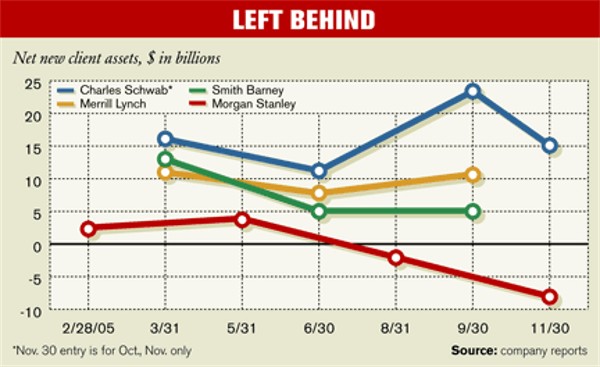
First, there was a nasty and very public battle to oust Morgan Stanley CEO Phil Purcell and then the new leadership fired 1,000 lower-producing financial advisors. The turmoil has resulted in an environment that has the firm's big producers looking for greener pastures.
From InvestmentNews:
When the former retail chief at New York-based Merrill Lynch & Co. Inc. takes over as president and chief operating officer of Morgan Stanley's individual-investor group, he will join a unit that sustained $8.1 billion in net outflows during its fiscal fourth quarter, ended Nov. 30.What did they expect?
Art and Malcolm


Art Garfunkel and Malcolm Gladwell are really the same person! You've never seen them together, have you?
Friday, January 06, 2006
The NASD flunks its exam

Imagine that you always dreamed of being a stockbroker. So you interview with a few firms and one of them agrees to take you into their training program. You decide to take the big plunge, you quit your job and embark on an exciting new career.
Your first order of business, pass the NASD Series 7, the exam everyone who does securities business with the public must pass. Your new employer will pay you a modest salary while you're in training, but one stipulation is that you must pass the Series 7 exam on your first try or they send you packin'.
For ten weeks you study hard and learn the material. You feel well-prepared for the day-long exam and confidently arrive at the testing center for your big test.
At the end of the day you press the button that says you're finished with your exam. "Are you certain?" it asks. You press "Yes". Your score appears.
Uh oh. A 68. You failed. Now you must return to your office the next day, gather your personal belongings and say goodbye to your new friends and the business you love. The dream is over.
Now imagine that months have passed, you're bagging groceries at the Piggly Wiggly and you come home to find a letter from the NASD saying that you actually passed the exam but a computer glitch caused your score to be miscalculated.
That's exactly what happened to nearly 2,000 people who took the exam between October 1, 2004 and December 20, 2005.
Now what?
The news story here.
Sunday, January 01, 2006
Smart and Simple...heavy on the simple
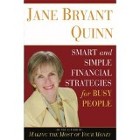 Jane Bryant Quinn claims that her new book, Smart and Simple Financial Strategies for Busy People is not a personal finance book for "dummies," but it's fairly elementary.
In her chapter titled "Better Investing", Jane defines a few investment terms for her readers:
The market refers to the activity of buying and selling. In a bull market, prices rise. In a bear market, they go down. How do you remember which is which? In bear markets you say "Grrrr."Geez.
But Quinn does a respectable job explaining the more basic principles of saving, debt reduction, real estate, insurance and investing. Her "No Worry" system for automatic investing is a set-it-and-forget-it approach for folks who lack the self-discipline, aptitude or inclination to spend much time with personal financial matters.
An example of the simplicity of her system, Quinn's solution for successful investing is a four or five index fund portfolio from Vanguard, T. Rowe Price or Fidelity. She even tells us exactly which funds to buy and, with only minor caveats, she recommends the same allocation for everyone.
"One size can't fit all." Maybe not, but one size can fit 95 percent of us and I'm one of that 95 percent. I suspect that you are too.The author has little to say in favor of financial professionals. She believes that financial advisors, insurance agents and real estate brokers should be consulted only as a last resort or when things get really dicey. These slick salespeople cannot be trusted and only add unnecessary expenses.
Quinn's notion that anyone with something to sell or who earns a commission is untrustworthy is a bit troubling. Couldn't it also be extended to authors?
Subscribe to:
Posts (Atom)