Wednesday, January 25, 2006

Hedge funds slowing but still growing


Inflows into the red-hot hedge fund industry cooled a bit in 2005...they only brought in $40 billion in new investments. That's just a 4% increase for the year compared with 19% in 2004.

While growth has slowed, don't expect hedge funds to go away, they have a legitimate place in the market. Besides, they continue to outperform the broad market. The Hennessee Hedge Fund Index rose 8.03% in 2005 while the S&P 500 showed just a 4.9% gain.

Monday, January 23, 2006

Janus launches long-short

In what could be the beginning of a new trend, Janus has launched a long-short fund utilizing a strategy typically only found in hedge funds.

The Janus Advisor Long/Short Fund will sell short shares of stocks the managers believe will decline in value and use the proceeds to invest in stocks with more favorable prospects. Until now, this aggressive "long-short strategy" has been the exclusive domain of hedge funds which have the regulatory flexibility to use more sophisticated investment techniques.

Hedge funds are typically only available to "accredited investors" or those with a high net income or high net worth and have a high minimum investment. The Janus fund has a minimum investment of only $10,000 and is available only through financial advisors.

Friday, January 20, 2006

25 years ago today...do you remember where you were?


(Click on it for larger image. Thanks Phil!)

Tuesday, January 17, 2006

Forty-cent letters


Stuck with a bunch of 37 cent stamps, I was forced to go to the local post office today for some 2-centers. With e-mail, online banking and the like, I just don't use the U.S. Mail often, but today, it couldn't be avoided.

The three vending machines in the lobby of the post office were all sold out of 2-cent stamps and my alternative was to stand in a twenty minute line. But wait, the machines had all of the three-cent stamps you could use in a million years! Geez.

I bought a dozen 3-cent stamps and just walked out shaking my head.

Monday, January 16, 2006

A proliferation of letters

InvestmentNews.com reports that there are now nearly 100 financial planning designations and counting and this proliferation is growing out of control. The fastest growth is in designations that are easy to get and offer little substance. InvestmentNews cites a new weath management certificate offered by Kaplan.
For instance, New York-based Kaplan Financial's Kaplan University offers a wealth management certificate to high school graduates who pay a tuition fee of $595, take seven online lessons in areas such as "asset allocation process" and "investment strategies," and pass an open-book test online.

The entire process "should only take maybe one month or three at most," a Kaplan admissions adviser said. Kaplan Financial is a division of Kaplan Inc., a New York-based subsidiary of The Washington Post Co.
In contrast, the CFP designation requires at least 1,000 hours of study, the completion of six courses, a series of exams and a grueling comprehensive final. CFP certificants must have at least three years of work experience as planners, adhere to a strict code of ethics, submit disclosure forms and complete 30 hours of continuing education every two years.

Until the industry can step up and regulate the quantity and quality of these designations, consumers need to be cautious. The letters that follow a financial professional's name may be practically meaningless. For information or to find a CFP practitioner in your area, contact the Certified Financial Planner Board of Standards.

Saturday, January 14, 2006

Invisible Hand Podcasts


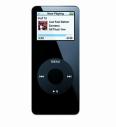
Three of my favorite things are finance, blogging and my new iPod Nano. They all come together at this site where you can download podcasts about business and finance. Wow, does it get any better than this?

Thanks to Financial Rounds and Marginal Revolution.

Ticker change for Morgan Stanley


Morgan Stanley, plagued by internal bickering ever since its merger with Dean Witter in 1997, is changing its ticker symbol on Tuesday from MWD to MS. The move is seen as another effort to eradicate corporate strife and more closely align the ticker with the company's name.

When Dean Witter was spun off from Sears along with the Discover Card in 1993 (Sears really did have everything) it adopted the ticker DWD for Dean Witter Discover and Company. DWD, affectionately referred to as "Doo Waa Ditty" by employees, merged with Morgan Stanley in 1997 and became Morgan Stanley Dean Witter. The ticker was changed to MWD.

Since the firm dropped Dean Witter from its name completely late in 2001 and is known simply as Morgan Stanley, the new ticker seems appropriate but it's not going to help management solve any of their internal problems.

Friday, January 13, 2006

Google: A stock disaster waiting to happen?

Google (GOOG) was not a publicly traded company when the internet bubble burst in 2000 sending stock prices hurtling back to earth. But with its stock trading at a euphoric 465-plus, could it face the same fate as those internet companies that came unglued nearly six years ago?

Henry Blodget's post titled "Google: The Bear Case" depicts an interesting scenario.
No one else is writing this piece, so it will have to be me. I should say upfront that I'm not predicting that this will happen (yet), and I'm certainly not making a recommendation. I'm just laying out a scenario that could kneecap Google and take its stock back to, say, $100 a share.
"Google's major weakness is that it is almost entirely dependent on one, high-margin revenue stream," Blodget writes. Eventually the growth of this revenue stream will cease causing valuation multiples to drop. But disaster really comes if search-ad fraud or click fraud increases. Ad revenues would drop dramatically compounding declines felt by an already maturing business and multiples would really tumble.

Henry Blodget was the head internet analyst at Merrill Lynch during the bubble years from 1998 until 2002. It was 2002 when Eliot Spitzer published Merrill Lynch internal emails depicting the fraud behind some analysts' published stock recommendations. In 2003 Blodget was charged with securities fraud by the SEC. He settled but is banned for life from the securities industry. His blog is called Internet Outsider.

Wednesday, January 11, 2006

Predictions for the S&P 500

It's January and that means that all of the big investment firms are out with predictions for the new year. And, like every year, the opinions are all over the board. Here are the S&P 500 predictions for 2006 from most of the major firms.

Prudential +22.6%
Citigroup +12.2
Morgan Stanley +12.2
AG Edwards +12.2
Goldman Sachs +12.2
Schwab +11.0
Lehman Bros. + 8.1
Banc of America +6.9
UBS +5.7
Merrill Lynch -1.9
JP Morgan -9.9

Isn't it amazing how analysts can be as much as 32 points apart?

(Anyone know how to get Blogger to do columns?)

Tuesday, January 10, 2006

Great sucking sound


Click on graph for larger version

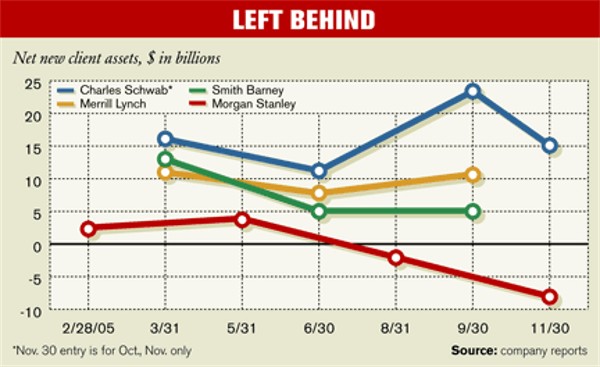
First, there was a nasty and very public battle to oust Morgan Stanley CEO Phil Purcell and then the new leadership fired 1,000 lower-producing financial advisors. The turmoil has resulted in an environment that has the firm's big producers looking for greener pastures.

From InvestmentNews:
When the former retail chief at New York-based Merrill Lynch & Co. Inc. takes over as president and chief operating officer of Morgan Stanley's individual-investor group, he will join a unit that sustained $8.1 billion in net outflows during its fiscal fourth quarter, ended Nov. 30.
What did they expect?

Art and Malcolm


Art Garfunkel and Malcolm Gladwell are really the same person! You've never seen them together, have you?

Friday, January 06, 2006

The NASD flunks its exam


Imagine that you always dreamed of being a stockbroker. So you interview with a few firms and one of them agrees to take you into their training program. You decide to take the big plunge, you quit your job and embark on an exciting new career.

Your first order of business, pass the NASD Series 7, the exam everyone who does securities business with the public must pass. Your new employer will pay you a modest salary while you're in training, but one stipulation is that you must pass the Series 7 exam on your first try or they send you packin'.

For ten weeks you study hard and learn the material. You feel well-prepared for the day-long exam and confidently arrive at the testing center for your big test.

At the end of the day you press the button that says you're finished with your exam. "Are you certain?" it asks. You press "Yes". Your score appears.

Uh oh. A 68. You failed. Now you must return to your office the next day, gather your personal belongings and say goodbye to your new friends and the business you love. The dream is over.

Now imagine that months have passed, you're bagging groceries at the Piggly Wiggly and you come home to find a letter from the NASD saying that you actually passed the exam but a computer glitch caused your score to be miscalculated.

That's exactly what happened to nearly 2,000 people who took the exam between October 1, 2004 and December 20, 2005.

Now what?

The news story here.

Sunday, January 01, 2006

Smart and Simple...heavy on the simple

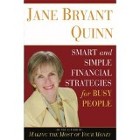
Jane Bryant Quinn claims that her new book, Smart and Simple Financial Strategies for Busy People is not a personal finance book for "dummies," but it's fairly elementary.

In her chapter titled "Better Investing", Jane defines a few investment terms for her readers:
The market refers to the activity of buying and selling. In a bull market, prices rise. In a bear market, they go down. How do you remember which is which? In bear markets you say "Grrrr."
Geez.

But Quinn does a respectable job explaining the more basic principles of saving, debt reduction, real estate, insurance and investing. Her "No Worry" system for automatic investing is a set-it-and-forget-it approach for folks who lack the self-discipline, aptitude or inclination to spend much time with personal financial matters.

An example of the simplicity of her system, Quinn's solution for successful investing is a four or five index fund portfolio from Vanguard, T. Rowe Price or Fidelity. She even tells us exactly which funds to buy and, with only minor caveats, she recommends the same allocation for everyone.
"One size can't fit all." Maybe not, but one size can fit 95 percent of us and I'm one of that 95 percent. I suspect that you are too.
The author has little to say in favor of financial professionals. She believes that financial advisors, insurance agents and real estate brokers should be consulted only as a last resort or when things get really dicey. These slick salespeople cannot be trusted and only add unnecessary expenses.

Quinn's notion that anyone with something to sell or who earns a commission is untrustworthy is a bit troubling. Couldn't it also be extended to authors?

Saturday, December 31, 2005

A toast to Champagne...and the New Year!

Before you pop that cork at twelve bells tonight, take a moment to appreciate the history of Champagne.

The name "Champagne" is derived from the Latin word campagna, originally used to describe the rolling countryside north of Rome. Since the Middle Ages it has referred to the province in northeast France which is known for its production of the bubbly beverage.

The seventeenth century Benedictine monk, Dom Perignon is frequently credited with inventing the process with which the best Champagnes are made, methode champenoise, a unique process where each bottle becomes its own fermentation tank. While how much credit for the invention of champagne should be given to Dom Perignon is still debated, there is little doubt that he was responsible for the concept of cuvee, where different grapes from different vineyards are blended to create a harmonious whole.

The elaborate and time consuming fermentation process, while automated for efficiency, is still used today. So, when you greet the new year, you're toasting with the product of centuries of tradition. Cheers!

Friday, December 30, 2005

Not so fast, Jane


A copy of Jane Bryant Quinn's new book, Smart and Simple Financial Strategies for Busy People showed up in the mail while I was in the Midwest for Christmas. You have to give these media relations folks credit for recognizing the power of blogging. They send a bunch of advance copies to bloggers for review and the resulting exposure a few blogs can give a new book is priceless.

Along with the book were several pages of press material prepared by Meryl L. Moss Media Relations including a list of "Six Automatic Savings Ideas" presumably from Quinn's book. The very first of these ideas is:
  • An Employer Retirement Plan. Diverting a percentage of your pay into a personal retirement account (e.g., a 401(k), 403(b), 457, Federal Thrift Savings Plan, etc.) has two advantages: first, there's no income or Social Security tax on your contribution and second, most employers match at least part of the money you put up.
Hold on just a minute. There is Social Security tax on your contributions to retirement plans. I wonder if Jane's book is full of such fallacies.

Tuesday, December 27, 2005

Headlights and windshield wipers


The weather here in the Great Midwest is 60 degrees and sunny while it's been raining non-stop back home in the Bay Area. Hopefully, all of the California drivers are heeding the new headlight/windshield wiper law that went into effect in July.

From the California Driver Handbook:
You must turn on your headlights if snow, rain, fog, or low-visibility (1000 feet or less) require the use of windshield wipers.
The idea that the legislature felt it is necessary to tell drivers to turn on their lights in the rain and fog raises an interesting question. Are California drivers really that dumb or do the lawmakers just think they are?

Wednesday, December 21, 2005

Merry Christmas!


The Happy Capitalist will be jetting back to the Midwest to celebrate Christmas with family and friends and blogging will have to take a backseat to holiday gatherings. But the laptop is along for the ride and I'll try to check in from time to time.

In case I don't have an opportunity later, let me wish everyone a very Merry Christmas and a Happy New Year!

Sunday, December 18, 2005

Money can buy happiness but...

Money actually can buy happiness but only if you have more of it than your peers. A recent study by Glenn Firebaugh, Pennsylvania State University and Laura Tach, a graduate student at Harvard, concludes that happiness is derived by the things money can buy (absolute income effect) or from comparing one's income to the income of others (relative income effect).
Firebaugh argues that, in evaluating their own incomes, individuals compare themselves to their peers of the same age. Therefore a person's reported level of happiness depends on how his or her income compares to others in the same age group. Using comparison groups on the basis of age, the researchers find evidence of both relative and absolute effects, but relative income is more important than absolute income in determining the happiness of individuals in the United States. This may result in a self-indulgent treadmill, because incomes in the United States rise over most of the adult lifespan.
The research puts an interesting spin on "keeping up with the Joneses". Firebaugh tested what he calls the "hedonic treadmill hypothesis" where "keeping up" means continually increasing one's own income because you can be sure the Joneses are increasing theirs.

Also, continued income growth in wealthy countries is irrelevant to the people's happiness because it could cause a consumption race just to maintain a constant level of happiness.

I say, give me the money and let me take my chances.

Friday, December 16, 2005

Cramer's Mad Money


CNBC seems to have a big hit on it's hands with Jim Cramer's "Mad Money". On the evening investment program Cramer runs wild on the set ranting about stocks and taking questions from callers. It's worth seeing...once.

OK, maybe there's some entertainment value to it, but the interesting thing is its impact on trading.

For example, last night's program featured Cramer raving about Sara Lee (SLE) while tossing frozen cheesecake around the stage. In today's trading SLE was up 3.5% on about five times its average daily volume. Apparently, some folks think he's worth watching.

Wednesday, December 14, 2005

Getting smarter...?

Americans seem to be getting a little smarter about handling their retirement savings, but we still have a ways to go according to a new report by the Employee Benefit Research Institute.

Slightly more than 43% of those who received a distribution from an employer's qualified plan in 2003 rolled the money into an IRA or another employer's plan, thus avoiding the immediate tax bite and penalty. This is way up from the 19% who did so ten years earlier in 1993.

It's likely that people understand the rules better now than in the past or perhaps financial institutions have done a better job marketing rollover products.

It's a big improvement but it's still pretty dismal. Too many people are cashing out lump sums and paying unnecessary taxes.

Monday, December 12, 2005

Vocabulary change for the Fed?

At long last, a Fed meeting to get excited about.

OK, maybe that's a bit extreme but seriously, tomorrow's meeting of the FOMC is the first in a long time that might be a little bit different. Sure, they're going to give rates a 25bp bump, just like the last twelve meetings, but it's the vocabulary that the media will be yammering about tomorrow afternoon. Will the words "accommodative" and "measured" be part of the policy statement?

Many analysts believe that, starting Tuesday, interest rate policy will no longer be referred to as "accommodative", signaling an approaching end to the tightening cycle. Then, after Alan Greenspan's final meeting on January 31st, the phrase "measured pace" will be lifted.

Gosh, the suspense is killing me.

Sunday, December 11, 2005

Vote your proxy

In the mid-eighties, when I first started investing in mutual funds, I would usually take the time to vote the annual proxies for the various fund families that I had invested with. But over the years, and since I get so much investment "stuff" in the mail, I've taken a much less active role...actually I pretty much ignore the proxies when they come.

So this fall, when a proxy from Janus showed up in the mailbox, it promptly hit the shredder. But a few weeks later, a second proxy showed up. That's unusual, I thought, but it too hit the shredder. Then a third proxy came. OK, what's the deal?

From InvestmentNews
Shareholders in Janus mutual funds are set to vote at a Dec. 29 meeting on a proposal that would attach performance fees to 13 of its 59 stock and bond funds.

Janus Capital Group Inc. originally had intended to put the proposal to a shareholder vote last month but postponed those plans after failing to get enough shareholders to cast a vote one way or the other.

If the proposal is approved, about $25 billion of the Denver-based company's $139 billion in assets will be linked to performance.
Most hedge funds are set up in a similar manner, where the management fees tick up if performance is above a specified benchmark but this is new for the mutual fund industry. Only about 4% of all mutual funds are set up this way, according to Lipper.

Proponents believe that this kind of structure more effectively aligns the objectives of the fund management with investors. I think we'll be hearing a lot more about it.

Saturday, December 10, 2005

KU wallops Cal

As a University of Kansas graduate currently living spittin' distance from the University of California at Berkeley, there's no way I could pass up posting on the thrashing KU gave Cal in basketball today.

The young and struggling Jayhawks trailed by three at the half but poured it on in the second period to beat the Cal Golden Bears 69-56.

Cal was probably fortunate that this game was played at Kemper Arena in Kansas City where the crowds and the noise are a little less intimidating to visitors than at Allen Fieldhouse in Lawrence.

Photo courtesy of the KU Athletics website.

Friday, December 09, 2005

Trademarking "Dykes on Bikes"


Dykes on Bikes are perennial favorites in San Francisco's Gay Pride Parade and I had no idea they were embroiled in such a legal battle over their identity.
A lesbian motorcycle group in San Francisco declared victory Thursday in their fight for a federal trademark for the name "Dykes on Bikes."

The U.S. Patent and Trademark office twice rejected the group's application on the grounds the term "dyke" was offensive and derogatory. The office reversed itself after the group's lawyers appealed, submitting hundreds of pages of additional material that they said showed the slang word does not disparage lesbians.
I'm so happy for them. After all, what could be more fun than hundreds of half-naked lesbians on motorcycles?

Wednesday, December 07, 2005

Neutral is "of little use"?

Through monetary policy, the Federal Reserve stimulates economic growth or restricts it, based upon its belief about what is in the best interest of the U.S. economy.

The idea of "neutral" refers to a rate that is neither so low that it stimulates excess spending, nor is it so high that it restricts spending and price increases. Most economists agree that neutral is between 3 and 5 percent. Since June, 2004 the Fed has raised its funds rate target from 1% to 4% and is expected to raise the target to 4.25% next week.

Since the Fed has a history of overshooting neutral, Rep. Jim Saxton (R, N.J.), chairman of the Joint Economic Committee of Congress asked Greenspan how he would know when neutral had been reached and whether the Fed might go past neutral.
While neutral "is a useful theoretical construct," practical difficulties "limit its usefulness," Mr. Greenspan wrote in a response released by the committee. Definitions of neutral vary, as do the methods for calculating it, and its level may change with economic conditions, he added.

"It is impossible to know with any certainty when the neutral rate has been reached." Moreover, at times, "when inflation is too high or too low -- aiming for a neutral funds rate in the near term would not be appropriate," Mr. Greenspan wrote.
Sorry Alan, but it is important to have an idea where neutral is, it's not just a "theoretical construct".

It's time for Alan to be done. He's done a respectable job, but we can do better.

Bigger butts, bigger needles

Apparently our butts have become so large that longer needles are needed to deliver the appropriate dose of medicine in some injections.
Standard-sized needles failed to reach the buttock muscle in 23 out of 25 women whose rears were examined after what was supposed to be an intramuscular injection of a drug.

Two-thirds of the 50 patients in the study did not receive the full dosage of the drug, which instead lodged in the fat tissue of their buttocks, researchers from The Adelaide and Meath Hospital in Dublin said in a presentation to the annual meeting of the Radiological Society of North America.
That's enough to get me back to the gym.

Tuesday, December 06, 2005

Choppiness defined

When I wrote only yesterday that we should expect a choppy market through year-end, I had no idea that today would prove to be such a great example.

The trading day began with a U.S. productivity report that was very positive and stocks responded as one might typically expect with such a good economic report. By around 3:00 est the Dow was up 101 points and the S&P 500 had risen eleven. Then the computerized sell programs kicked in and investors followed giving up nearly all the the day's gains. The Dow finished up 21.85 and the S&P 500 up only 1.61.

And while many positive economic reports can be interpreted as inflationary, positive productivity reports are much different. Productivity is total output divided by hours worked, so a strong number implies that inflation is pretty much in check. The same number of workers are producing more goods in the same amount of time. But after a few hours to digest the info, the market sold off anyway.

Expect more of the same as the month winds down.

Monday, December 05, 2005

Expect a choppy December

November's strong performance for equities has moved the Dow to just about even for the year and we're up about four points on both the Nasdaq and S&P 500. So, what factors moved the market last month and what should we expect from December?

In my view, the recent upturn was driven by the following factors:
  • Solid third quarter earnings reports.
  • Oil dropped from $70 per barrel and has stayed below $60 for weeks.
  • Solid consumer confidence numbers suggesting a strong retail holiday season.
  • Lower inflation expectations.
  • The expectation that the Fed is near the end of its tightening cycle.
Regarding the Fed, we'll most likely see two more 25bp hikes, which is probably two more than necessary given the Fed's history of overshooting neutral. The result will be a sluggish 2006 economy with the chance of a negative GDP growth rate in at least one quarter. By the end of the new year the Fed may have to contemplate a reversal in interest rates.

With this remaining uncertainty about the Fed in the near term, any good economic news will cause worries that the Fed's tightening is unfinished and drive stocks down while negative economic news would trigger the opposite.

My forecast is for a choppy market through the end of the year. A Dow above 11,000 this year is looking about as likely as a white Christmas in San Francisco. Oh well.

Sunday, December 04, 2005

Smart money?


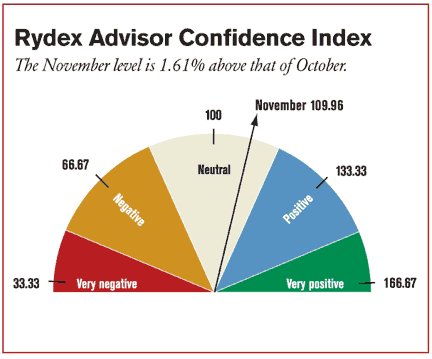
Registered Investment Advisors polled last month by Rydex had a slightly upbeat outlook on the economy and the stock market. Now you just have to ask yourself if you should follow the "smart money" or if this is actually a conta-indicator?

(Click on the graphic for a larger image).

Friday, December 02, 2005

The Happy Capitalist Turns One


Tomorrow, December 3rd, The Happy Capitalist will turn one year-old. It's hard to believe that a year can go by so quickly.

I won't be around to help celebrate as I'll be in San Francisco taking "The Big Exam" all day. The blog will just have to celebrate by itself...I hope it throws itself a nice party.

More importantly, tomorrow is my mother's 80th birthday. Happy birthday, Mom!

Wednesday, November 30, 2005

Neglected nest eggs


A recent study by the mutual fund giant Vanguard Group suggests that investors don't pay much attention to their retirement savings and often don't diversify well.
The fund firm looked at more than five million people with employer-sponsored defined-contribution plans or individual retirement accounts that it administers and found that during the first six months of 2005, only 10% of investors in the defined-contribution plans and 8% of IRA owners made any trades within the accounts.
Vanguard also found that a large percentage of IRA owners and defined contribution plan participants only invest in a single asset class or a single mutual fund.

While it's true that many investors are not well diversified, here's the important thing to note about this particular study: the sample was 5 million Vanguard clients. Vanguard, as a financial services provider, attracts clients who want to invest on the cheap. Its customers want low fees and no help. They have been convinced by the popular financial media that the most important aspect of investing is price, the cheaper the better. Service and education are lower priorities. Is it really surprising that their accounts are in such sad shape?

Tuesday, November 29, 2005

Rumsfeld gets it


The mainstream media are having a heyday with Rumsfeld's declaration today that the enemy in Iraq are not "insurgents". He's late to the party but he's absolutely right.

From the SF Chronicle:
More than 2 1/2 years into the Iraq war, Donald H. Rumsfeld has decided the enemy are not insurgents.

"This is a group of people who don't merit the word `insurgency,' I think," Rumsfeld said Tuesday at a Pentagon news conference. He said the thought had come to him suddenly over the Thanksgiving weekend.
They are guerrillas, they are terrorists, they are lowlife scum of the earth, they are assholes, but they are certainly not insurgents.

Webster defines insurgent as, "Rising in revolt against established authority, especially a government." These cowardly half-wits with explosives don't have the sense to understand revolt. The only thought in their heads is that killing innocent civilians somehow makes them great in the eyes of Allah. Huh?

Monday, November 28, 2005

Black Friday and Cyber Monday


I don't recall ever hearing the phrase "Black Friday" so much as I've heard it this year. It refers to the day after Thanksgiving when so many retailers finally go into the "black" for the year. And this is the first year I've heard the phrase "Cyber Monday", referring to the quantity of online shopping done on the Monday following Thanksgiving. But it's apparently significant.
The Monday after Thanksgiving, nicknamed "Cyber Monday," is the unofficial kickoff of the Internet holiday shopping period. It has become a huge online shopping day in part because after a long Thanksgiving weekend of comparing prices and exchanging gift ideas, many shoppers return to the high-speed Internet connections in their offices ready to buy electronically.

Online Christmas sales already had jumped over the four-day Thanksgiving weekend. Americans spent $305 million online Friday, up 22% from the same day a year ago, according to research firm comScore Networks. Research firm Nielsen/NetRatings said its Holiday eShopping Index, which tracks traffic to 100 Web sites, jumped 29% Friday from a year earlier.
Both traditional and electronic retailing is off to a rapid start this holiday season. Will it hold up?

Sunday, November 27, 2005

We're shakin'


About ten minutes ago, the house took a pretty good jolt. From the USGS website:
Magnitude 2.4
Date-Time Monday, November 28, 2005 at 05:37:32 (UTC)
= Coordinated Universal Time
Sunday, November 27, 2005 at 9:37:32 PM
= local time at epicenter
Location 37.840°N, 122.22°W
Depth 5.6 km (3.5 miles)
Region SAN FRANCISCO BAY AREA, CALIFORNIA
Distances 2 km (1 miles) NNE (15°) from Piedmont, CA
5 km (3 miles) E (85°) from Emeryville, CA
5 km (3 miles) N (3°) from Oakland, CA
18 km (12 miles) ENE (67°) from San Francisco City Hall, CA
These coordinates put this little temblor on the Hayward fault about a mile from our house. These days we're thinking that these small releases are keeping the really big shifts from occurring. Why would anyone live in a place like this?

Ka-ching!


The American consumer continues to be the strongest leg of the U.S. economy even with the dampening effect of higher energy prices. From the WSJ:
Charge-card company Visa USA reported retail sales using its cards rose over 11% to $3.7 billion for Friday and Saturday, from the same two-day period last year. Sales of electronics, books and CDS jumped 21%, while specialty-retail and hobby sales increased 16% and discount and drug-store sales climbed 10%.
Solid retail sales through December could be just the ticket to propel the Dow above 11,500 by year-end.

Friday, November 25, 2005

Built to last

Less than a year out of college and living in my first real apartment, one of my first "major purchases" was a Weber Kettle for around 50 bucks. I was sleeping on a bed that I bought used in college for $25, I didn't own a sofa and my TV was a 12-inch black and white, but I had to have a grill.

Pictured above is yesterday's Thanksgiving turkey on the very same grill I bought in the spring of 1981. It has spent its entire lifetime outdoors, uncovered. It's been used at least weekly, rain or shine or bitterly cold. Yes, I've been known to shovel a path out to it to roast a turkey or tri-tip or just plain ol' burgers.

Yesterday Mrs. THC suggested that someday it might have to be replaced. I don't know...I think it might have another 25 years left in it.

Wednesday, November 23, 2005

Big Exam

The Big Exam is just ten days away. Maybe afterward blogging can return to its former regularity. In the meantime I'll be spending all of my time with books and the HP 12C.

Wednesday, November 16, 2005

What can Brown do for you?


I was working in our home-office this evening when I was startled by something hitting the front door--hard. I ran to the front door only to see a UPS truck driving off. It was obvious what had happened. The driver had thrown a package and hit the front door, probably without even getting out of the truck. UPS would have to hear about this. I couldn't believe it.

I called the main UPS customer service number and spoke with a nice woman who agreed that this was not how their drivers are trained. She was very apologetic and promised that I would hear from someone at our local distribution center.

Not fifteen minutes later I received a call from a local supervisor who was also very congenial and apologetic. He admitted to me that this driver had other problems and he wasn't terribly surprised by my complaint.

So I asked, "Why is this guy still on your payroll?"

I got a two-word answer, "He's union."

"What? You've got a driver pissing off customers and you can't fire him?"

"It's really hard. You have to have a lot of documentation before you can even think about going to the union to try to get rid of him."

The supervisor thanked me for taking the time to report the problem and said he'd discuss it with the general manager of the facility but I got the impression that it wouldn't go any further. Actually, I'm even a little fearful of retribution, this driver is on our street every day.

How did labor unions become so powerful that thoughtless and irresponsible employees are protected? There may have been a time in America when unions served a legitimate purpose, but aren't we beyond that now? Shouldn't a business be able to fire someone who is an embarrassment and a liability?

Sunday, November 13, 2005

Go long French autos


Go long French automakers. In the eighteen days of rioting in France, more than 7,000 automobiles have been destroyed.
Since the wave of violence started, the daily damage report posted by the French police has been a car owner's nightmare: 502 burned on Friday night, 463 the previous night, 482 the night before that, and so on.

No other country in Europe immolates cars with the gusto and single-minded efficiency of France. Even during tranquil periods, an average of 80 vehicles per day are set alight somewhere in the country.
These cars will have to be replaced and, most likely, will be replaced with new Renualts, Citroens and Peugeots. Looks like a good year for French autos.

Saturday, November 12, 2005

Vanguard raises minimums


Vanguard is tripling the minimum investment required to open an IRA from $1,000 to $3,000, and doubling the minimum on Education Savings Accounts, from $1,000 to $2,000.
"It's unfortunate, to say the least, that one of the best-run mutual fund companies in the country is pricing itself out of the market for middle-income investors," Barbara Roper, director of investor protection at the Consumer Federation of America, told Phillyburbs.com.
This isn't surprising. As the expenses that go along with servicing small investors increases we'll see more and larger minimums. It's a real squeeze for firms like Vanguard--they loose money on small accounts and, as investors acquire more significant investable assets, they leave to seek professional help from full service firms. It's no wonder Vanguard has started courting financial advisors at the big brokerage houses.

Wednesday, November 09, 2005

Load up the truck!


Two years ago Californians fired Governor Gray Davis, only nine months into his second term and hired Arnold Schwarzenegger. It was all about fixing a broken system. Voters demanded reform.

Yesterday the voters of California said, "just kidding".

Californians defeated all eight propositions at voting booths yesterday. Arnold's "top props", Propositions 74-77 would have taken steps to reform state politics and California's sad schools.

Under Prop 74, school teachers would become tenured at 5 years instead of 2. Why should they get tenure at all?

Prop 75 would have made labor unions get employees' permission before making political contributions with their union dues. Doesn't that make sense?

Prop 76 would have placed reasonable, responsible limits on state budget growth. Oh no, not responsible spending!

Prop 77, endorsed by all the major newspapers in the state, would have stopped politicians from drawing their own election districts and made redistricting the responsibility of a panel of non-partisan judges. There's no reasonable explanation that this one failed.

They all seemed pretty sensible but they all went down in flames.

We'll be loading up the truck and heading back to Kansas but first, I want to see what life in California is like under our third actor-governor, Warren Beatty.

Monday, November 07, 2005

Wine country foliage

On our last trip to Sonoma County we were accompanied by our good friends Vavoom and Mrs. Vavoom. So naturally, this weekend we thought of them often as we ate and drank our way through the Russian River Valley. This beautiful tree outside our B&B made us think of them even more as they are now residing in New England, famous for its foliage. How does this compare, Vavoom?

Saturday, November 05, 2005

U.S. Housing: A soft landing?

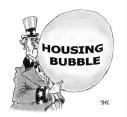
Last week we took a look at some pretty compelling evidence that the U.S. housing market is a bubble ready to burst. There is already a great oversupply in housing, the Fed will overshoot neutral causing the yield curve to invert and high energy prices will have a profoundly negative effect on the U.S. economy. The combination of these factors will cause a "perfect storm" for the housing market.

Today, we'll examine the argument that prices will moderate but supply will not dramatically outpace demand and the market glides in for a perfect landing.

Housing
In this scenario, both demand fundamentals (household formation from immigration and population growth) and affordability (interest rates and wages) continue to prop up home prices. While the supply of new homes for sale is currently at 4 1/2 year highs, this supply level will remain manageable because long-term interest rates are still close to historical lows, the rate of new ARMs is declining and a pullback in the use of home equity loans has begun.

A Steepening Yield Curve
While the Fed has raised the discount rate 12 consecutive times, from 1% to 4%, and could continue to tighten, there is no danger that the Fed could "overshoot neutral". Even if rates rise another 50-75 basis points, that would not be restrictive for growth. There will be no yield curve inversion and we may, in fact, see inflation creep upward.

Energy Prices Moderate

While higher prices, especially for natural gas this winter, will be economically dampening, this will be temporary and manageable. We've already seen oil prices fall significantly and they will continue to moderate and stabilize below $60/barrel.

Provided that these factors hold true, a bubble-bursting dramatic decline in housing prices is not likely.

Data from the October 27, 2005 ML RIC Report

Russian River Valley


The Russian River Valley is one of the finest grape growing and wine making regions anywhere and this weekend we're taking some time to relax here.

This year, 57 wineries are participating in "A Wine and Food Affair-Tasting Along the Wine Road". It's a weekend full of food and wine--pretty tough duty, but somehow we'll get by.

Thursday, November 03, 2005

Off with their thumbs...or whatever

The mayor of Las Vegas has an interesting solution for the city's graffiti problem.
Las Vegas Mayor Oscar Goodman has suggested that those who deface freeways with graffiti should have their thumbs cut off on television.
What do you suppose he would have done with rapists?

Wednesday, November 02, 2005

Allies and Molotov Cocktails

From the San Francisco Chronicle:
An anti-Bush demonstration in San Francisco ended with the arrest of several people, including one who was found carrying several Molotov cocktails after such a device was thrown at The San Francisco Chronicle building on Wednesday, police said.
Just a couple of points: First, how much sense does it make to protest war by throwing bombs? Secondly, lamebrain, the Chronicle is on your side.

Monday, October 31, 2005

Stansky surrenders helm at Magellan

Fidelity announced today that Robert Stansky, long-reining manager of the Magellan Fund, is retiring but his legacy may be clouded by the fund's faded performance.

Magellan, a $52 billion fund has consistently underperfomed the S&P 500 during Stansky's tenure. The fund has averaged a 6.85% total return over the last ten years while the S&P 500 averaged 9.49%. Critics debate whether a fund of Magellan's size can be managed by one person.

Footnote: When Peter Lynch took over the fund in 1977 it had only $20 million in assets.

Sunday, October 30, 2005

U.S. Housing: A triple whammy?

The debate over the fate of the U.S. housing market rages on and no one can be sure how it will play out but here's a three-pronged argument supporting a bubble bursting theory.

Supply and Demand
It's a simple case of supply and demand. Housing starts, annualized, have exceeded two million units for six consecutive months which has only happened three other times in modern history. Household formation last year was much lower than it was during any of the three other periods. The result is an oversupply in housing that is beginning to be evident. The backlog of unsold new homes has moved to a 4.9 month supply, the highest since December of 1996.

Yield Curve Inversion
The Federal Reserve has raised rates eleven times in sixteen months and has given little indication of letting up. Over the last three decades there have been eight other tightening periods and the yield curve inverted five of those times as a result of the Fed "overshooting neutral". The U.S. economy slipped into recession as a result of all five of those Fed-induced inversions.

Energy Prices
Energy prices have more than doubled in the last year and, with more than half of American homes heated by natural gas, an impact on consumer discretionary spending is a given. Households have spent $100 billion more on energy this year than last and, while energy prices have eased a bit, we're likely to hit $150 billion by year-end. Add to that the impact of higher short-term interest rates and we can subtract 2-3% from consumer spending. Merry Christmas.

Seem dismal? Later we'll take a look at the arguments for a soft landing.

*Data from the October 27, 2005 ML RIC Report

Friday, October 28, 2005

Bearish on Google


Shares of Google soared past $358 yesterday, more than quadrupling their IPO price from last year. And while the average target price of 22 analysts surveyed by Reuters Estimates is $384.55 for Google, one analyst has a "sell rating" on it and a target of $225.
But Eugene Walton of Walton Holdings LLC in New York reiterated his "sell" rating, although he raised his 12-month price target to $225 from $200.

Mr. Walton runs a one-man independent research firm out of his apartment on Manhattan's Upper West Side. He set up shop after the big 2003 settlement with regulators that required some of the largest Wall Street brokerages to offer independent research to their clients alongside their in-house reports.
How does a guy like this end up being featured in the WSJ anyway? I suppose it's the whole "Man bites dog" thing they told us about in journalism school.

Wednesday, October 26, 2005

Of geese and homeless people

Lake Merritt is home to hundreds of Canadian geese that have made Oakland their permanent residence. Migratory by nature, these waterfowl have decided there's no reason to leave. Flying south for warmer weather and abundant food just isn't necessary as the weather in Oakland is mild year 'round and the good citizens completely ignore the signs not to feed them.

Oakland's homeless are a lot like the geese. They've just decided to stay because the weather is nice and people feed them. I only wish they wouldn't pee on the sidewalk.

Monday, October 24, 2005

Stuck with Chuck


Charles Schwab says he's staying put as CEO of the company that he founded and that bears his name.
"I will remain here as CEO as long as it takes, but not a day longer," Schwab said. "I will remain as chairman probably indefinitely."
Ya gotta love the "not a day longer" part. My guess is that he's gone before the end of '06.

Sunday, October 23, 2005

The second hundred years

Scientists are thawing the remarkably well-preserved body of a WW II airman that has been encased in glacial ice ever since his plane crashed, probably in the 1940s.
FRESNO, Calif. - As the frozen body believed to be a World War II airman slowly thaws after decades encased in a glacier, forensic experts say a picture is emerging of a fair-haired man in an Army uniform who suffered broken bones when his aircraft crashed in the wilderness.
I'm really showing my age, but this reminds me so much of the 1967 sitcom,The Second Hundred Years.
While prospecting for gold in Alaska in 1900, Luke Carpenter, thirty-three years of age, was buried and frozen alive when caught in an avalanche. Sixty-seven years later, Luke's Son, Edwin Carpenter, sixty-seven years of age, widower and retired businessman, is informed of a recent avalanche in Alaska and of a find--his father, alive. Luke was brought to the home of his now aging son in Woodland Oaks, California. Chronologically Luke was 101, but he hadn't aged while in deep freeze and was physically still 33--younger than his own son.
Why do I devote valuable brain space to remembering stuff about a 38 year-old TV show?

Wednesday, October 19, 2005

Who needs a degree, anyway?


Elizabeth Paige Laurie has returned her degree to USC after being accused of paying her freshman year roommate to do her homework.

Laurie is the daughter of Bill and Nancy Laurie, billionaire daughter of Wal-Mart co-founder, Bud Walton. Bill and Nancy had given the University of Missouri at Columbia $25 million for a sports arena and asked to have it named after Paige. When the allegations of her college highjinks surfaced, MU was forced to take Paige's name off of the project.
"Paige Laurie voluntarily has surrendered her degree and returned her diploma to the university. She is not a graduate of USC," the school said in a statement dated Sept. 30. "This concludes the university's review of the allegations concerning Ms. Laurie."
Call me crazy, but somehow a degree from USC just doesn't seem to mean so much when your parents are worth billions. It's not as if she needs that bachelor's degree to get a job.

Tuesday, October 18, 2005

Carnival of Personal Finance


This week's Carnival of Personal Finance is up at MyMoneyBlog. Knock yourself out.

Monday, October 17, 2005

Tax cheats


Nine new KPMG officials, including the former CFO, were named today in a criminal indictment on charges of tax-shelter fraud.
U.S. regulators said in a statement this is now believed to be the largest criminal tax case ever filed, which generated at least $11 billion in fraudulent phony tax losses and resulted in at least $2.5 billion in tax evaded by wealthy individuals.

KPMG said in a statement, "All of the nine individuals who received indictments today separated from the firm at an earlier time. Therefore, since the indictments do not involve the firm, it would be inappropriate for KPMG to comment further."
Yeah, since we fired 'em we don't think we need to dicuss it further. In spite of the fact that they (allegedly) designed, marketed and implemented the illegal tax shelters for KPMG clients while employed by KPMG.

Sunday, October 16, 2005

Financial Illiteracy


A recent poll by the Roper Center for Public Opinion Research reported that the average American family spent $1.22 last year for each dollar it earned and 1.6 million Americans filed for bankruptcy.

According to U.S. News and World Report, 25% of workers age 45-54 have less than $25,000 saved for retirement.

Cardweb.com reports that in 2004, average household credit card debt rose to $9,312 from $7,842 in 2000.

These figures accurately point out that many Americans are financially illiterate. And this concern looms even larger when you consider that we are being asked to take on more and more personal responsibility through tougher bankruptcy laws, consumer-driven health insurance plans, possible Social Security reform and the shift from guaranteed pension plans to defined contribution plans.

An editorial in InvestmentNews suggests that these problems would improve if financial literacy could be raised. While schools have begun to take on this task, they have not embraced it wholeheartedly. It is up to the financial services industry to raise consumers' awareness and help people understand the steps they need to take for their own financial well-being. It's going to take a great deal of hard work.

Friday, October 14, 2005

Vintage fire


This is the sort of fireside scene one expects if the fire resulted in the loss of loved ones or pets or perhaps the family home. But this was really bad. The sobbing and shocked expressions stem from the loss of something really irreplaceable.

Up to $100 million of California's finest wine was destroyed Wednesday in a huge warehouse fire.
Tens of millions of dollars worth of vintage wine were believed to have been destroyed by a relentless fire Wednesday at a huge Vallejo warehouse that was considered one of the most secure places for wineries and individuals to store prized collections.

The three-alarm fire at Wines Central sent plumes of smoke more than 700 feet high that could be seen for miles. The blaze could not be controlled by firefighters because the Mare Island building -- a 1942 structure that once housed Navy torpedoes -- had steel doors and 3-foot-thick concrete walls and a concrete roof that could not be penetrated.

Saturday, October 08, 2005

Part D, what you must know


The long-awaited Medicare prescription drug coverage begins January 1st, 2006 and, if you're a participant in Medicare, you can sign up as early as November 15th. What you must know is that doing nothing is not an option. You need to look at the alternatives and make a choice.

Medicare beneficiaries will be able to choose from at least two of the stand alone drug plans that contract with Medicare to provide the new benefit. If you do not sign up by May 15th, 2006 however, you will pay higher premiums for the rest of your life--to the tune of 1% for each month late that you sign up. Exceptions are participants who are covered by an employer-sponsored plan that is at least as rich as the new Medicare plan. They can stay with that plan as long as they like and will not be penalized for joining Part D later. Weigh your options.

Here's how the drug plan works: The participant pays the first $250 in prescription costs as the deductible. Of the next $2,000 spent for prescription drugs, Medicare picks up 75%, the participant, 25%. So, of the first $2,250 spent, the participant pays $1,136, $386 in premiums ($32.20 per month), the $250 deductible and $500 as the 25% co-pay.

Now is where the plan gets a little strange. It covers nothing from $2,250 to $5,100, the "catastrophic level". Zip, zero, nada. This has come to be known as the doughnut hole. Then, above $5,100, Medicare pays 95%.

The rules are a bit convoluted, just like anything in government. But the plan offers tremendous protection against having to pay huge sums for prescription drugs in the event of catastrophic illnesses.
Friday, October 07, 2005

Sex, lies and doctors

This story has been making the rounds today, but everyone is missing the most important question.

An Oregon woman is suing her doctor because he claimed that he could remedy her lower back pain by having sex with her. There were a number of 45 minute sex sessions, for which the Oregon Health Plan paid the doctor $5,000. Think of it, not only did this guy convince a woman that there was therapeutic value in having sex with him, but he got the state to pay him for his time. Brilliant, except that he lost his medical license and had to spend 60 days in jail.

What I'd like to know now is, how's the woman's back?

Tuesday, October 04, 2005

We win!


Back in early June I posted about PG&E's 20/20 Summer Savings Program. The utility challenged its customers to reduce their average daily usage of electricity by 20% cumulatively for June through September and those who were successful would be rewarded with a 20% rebate on all electricity used for the period.

Twenty percent is a lot to shave off a household's electrical usage, but they dared us, dammit. So for four months we were diligent about turning off lights and eliminating unnecessary consumption. We won. The September bill came yesterday and it showed a 22% reduction in consumption for the period. Take that, PG&E!

I suspect that the most important steps I took were turning off the seldom-used little refrigerator on the wet bar and unplugging the Insta-hot water dispenser at the kitchen sink. Nice conveniences, but we've hardly missed them.

It also didn't hurt that we didn't run the air conditioner for a single day during the period. We never needed it and we probably only ran it for a handful of days during the same period last year.

I haven't done the math but I don't think our rebate check will amount to more than $75. Oh well, it wasn't about the money, it was about the challenge!

Saturday, October 01, 2005

Bloggers' Paradise


Imagine, free internet access anywhere in San Francisco.
Google Inc. has offered to blanket San Francisco with free wireless Internet access at no cost to the city, placing a marquee name behind Mayor Gavin Newsom's effort to get all residents online whether they are at home, in a park or in a cafe.
The implications are amazing.